
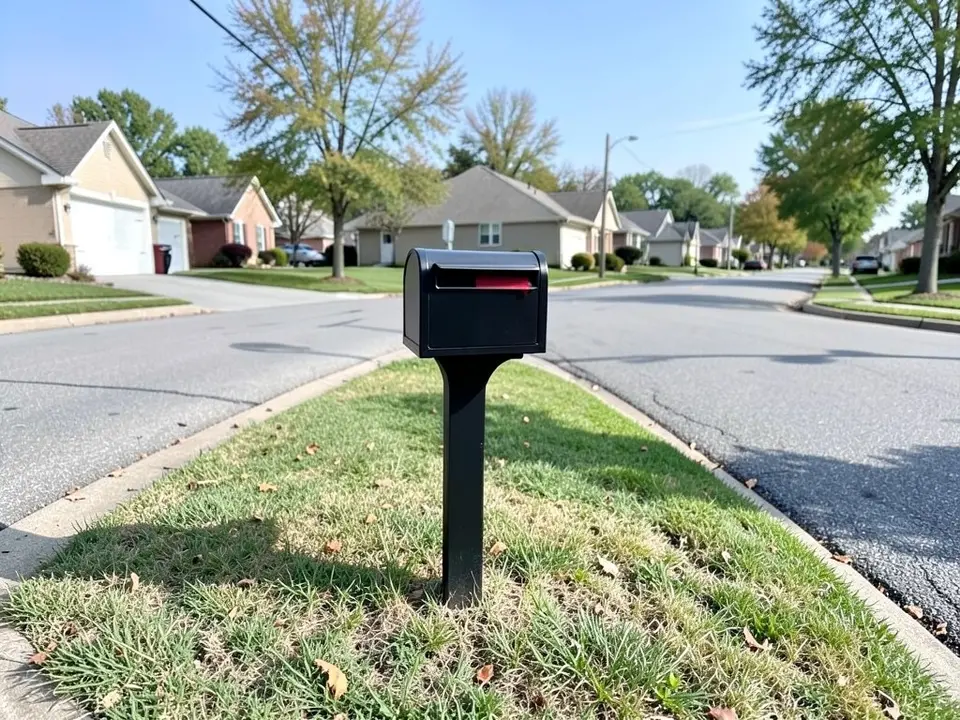
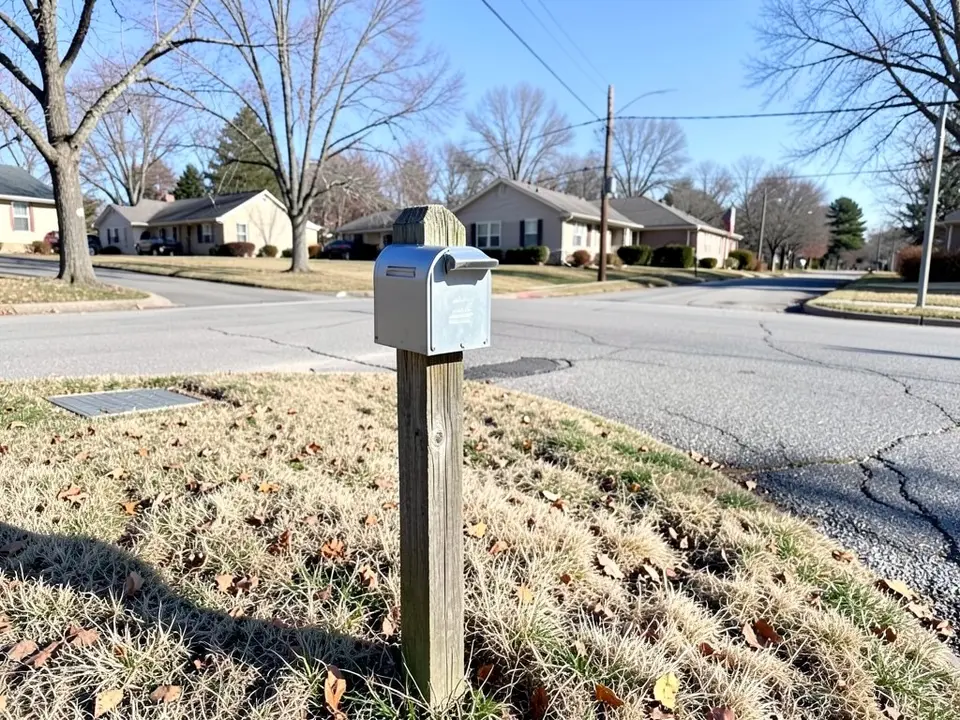
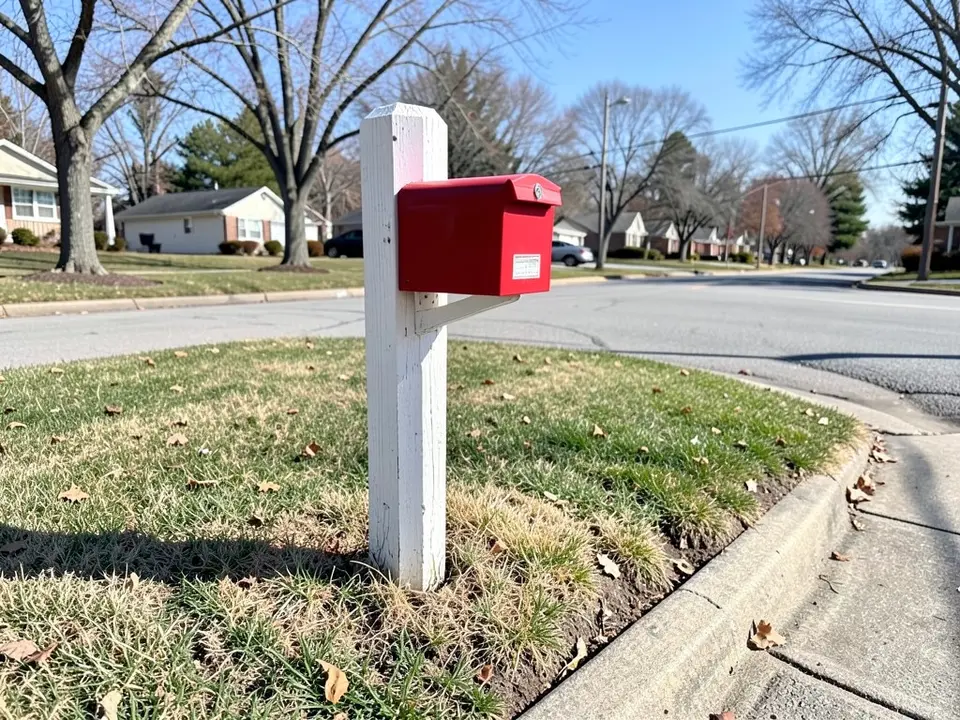
What the pages suggest for the bed
These ideas come from Bob Vila (Savannah Sher, March 13, 2025), Fresh Patio (Dakota Crawford, March 29, 2024), ShrubHub (January 11, 2023, updated May 24, 2023) and the USPS Postal Bulletin. ShrubHub has a shop and design services. None of it is tested at your curb.
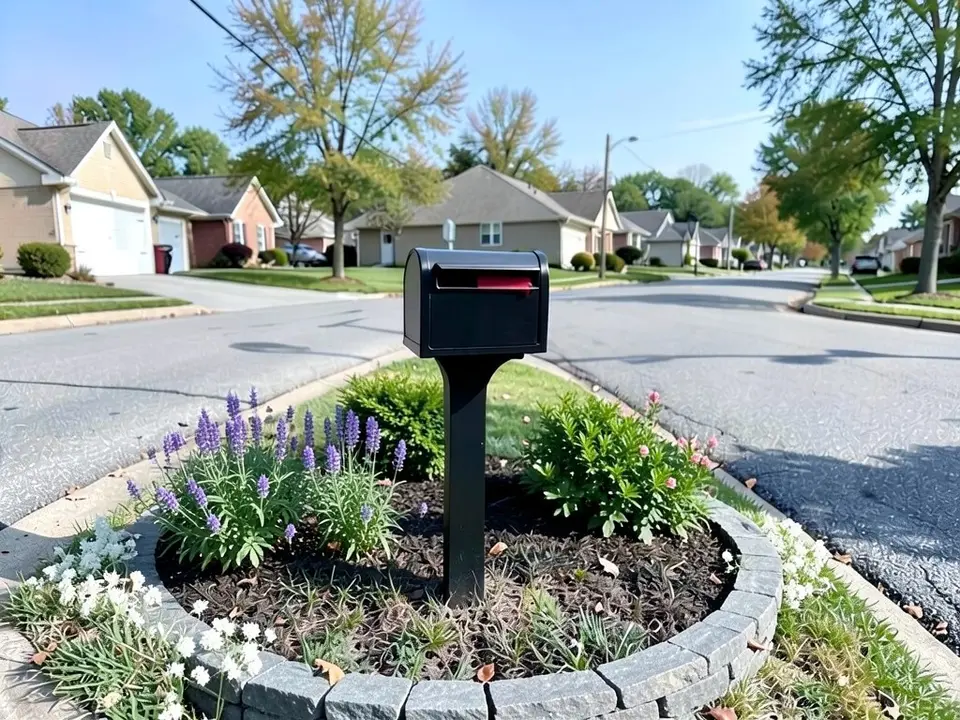
- A circular bed: Bob Vila describes woody shrubs, perennials and low pink and white border flowers around a black mailbox, with curved edging that defines the mowing boundary. Our first example is this layout.
- Mixed perennials: Bob Vila suggests yellow plants, burgundy foliage, ornamental grasses and flowers with curved edging, and drought-tolerant perennials for low maintenance.
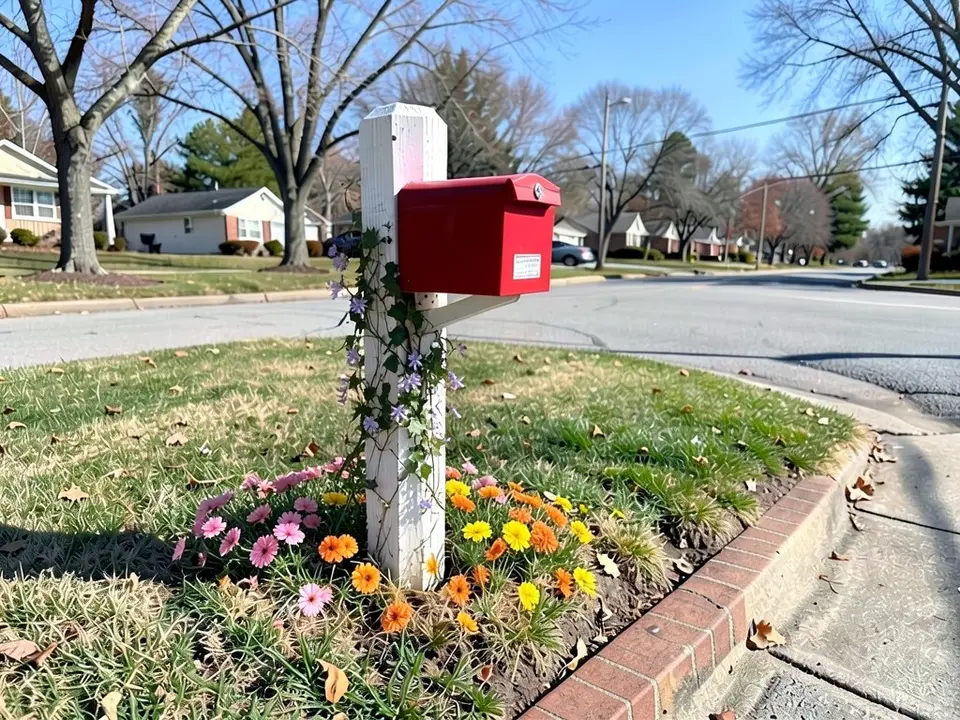
- A cottage garden: Bob Vila suggests roses, climbing vines and perennials around a red mailbox, and plants with long bloom periods. ShrubHub suggests an informal layout with a shrub rose or ornamental grass backdrop. Our third example is this style.
- A cutting garden: Bob Vila suggests zinnias, sunflowers and other annuals, mixed heights so the bed looks good from all sides, and sturdy stems that stand up to regular cutting.
- A pollinator strip: ShrubHub suggests a strip of salvia, lavender, coreopsis and yarrow to attract butterflies.
- A raised bed: ShrubHub says a raised flower bed adds definition and is easier to maintain. Bob Vila describes a cabin-shaped novelty mailbox on a stone wall with lilies and daylilies, and says the raised position helps drainage.
Ground cover and edging
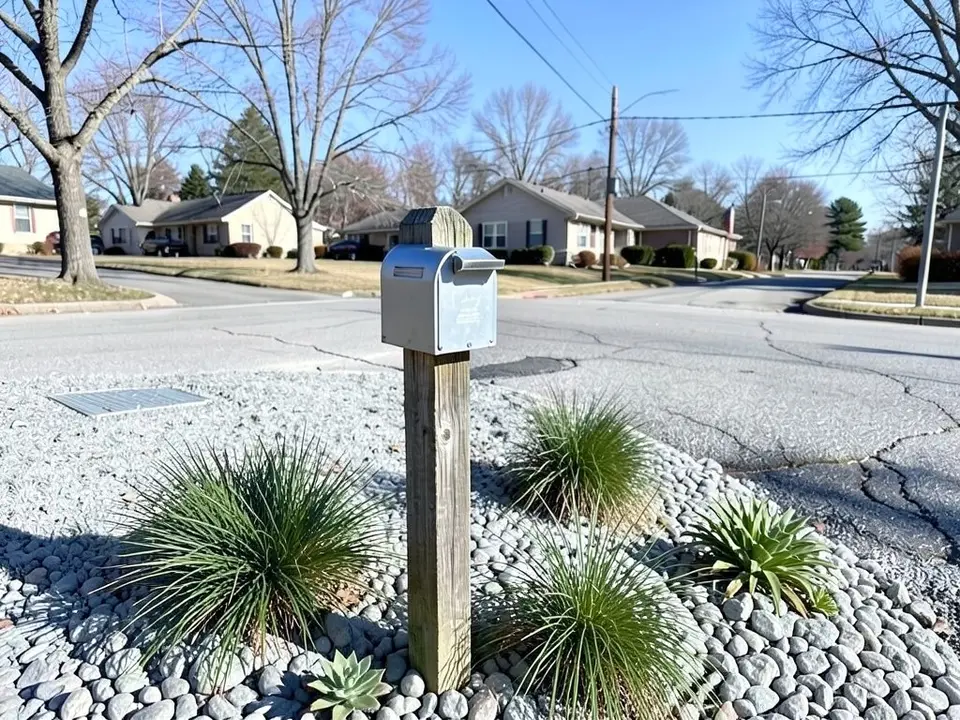
Our second example is the rock idea, and all three show an edge or its absence.
- Black mulch: Fresh Patio says it sets off plants and pairs well with a black mailbox, and that for annuals it keeps the soil moist and the roots cooler in summer than stone does.
- Rock: Fresh Patio suggests mixing large and small rocks in varied colours for a natural look, and says lighter rocks stand out against a black mailbox. It says rock costs more at the start but does not need yearly replacing. It suggests river rock with perennial bunch grasses for a modern metal mailbox, which is low maintenance. ShrubHub suggests mixing rock sizes or combining pebbles and river rock, and adding succulents for colour.
- Stone edging: Bob Vila quotes Christopher DeFeo of Landscape Barn saying decorative stone at the edges is durable and lowers maintenance. Fresh Patio says a full-circle granite border can be free if you already have rocks, that two stacked layers add height, and that a single layer of small stones suits small yards.
- Plastic edging: Fresh Patio says it is cheap and bendable but that winter pushes it out of the soil, so it needs re-hammering.
- On a slope: Fresh Patio says to stack flagstones higher in front and lower at the back to keep a bed level on a slope.
Plants, heights and vines
Our third example has a vine on the post.
- Mix the heights: Fresh Patio's rule of halves is to mix plants of different heights so none overshadows another. Its example pairs multiflora petunias (10 to 12 inches) with Rustic Orange coleus (18 to 24 inches).
- Perennials and annuals: Fresh Patio lists hostas, boxwoods, lilies and tulips as perennials that return each year, and marigolds, petunias, pansies and mums as annuals for spring or fall colour. Sunflowers add height and need full sun. Bob Vila suggests mixing annuals and perennials for year-round colour.
- Vines need little ground: Bob Vila says a flowering vine on a white mailbox needs little ground space, which suits narrow roadside areas, and that defined edging protects the planting from accidental damage.
- Which vine: ShrubHub gives bougainvillea as zones 9 to 11 and usually grown as an annual, clematis as zones 4 to 9, and star jasmine as zones 8 to 10. Fresh Patio says ivy on brick needs trimming once or twice a year and suggests vinca as a low companion that avoids blocking a lantern.
- Low-care plants: ShrubHub suggests ornamental grasses and easy perennials such as salvia, lamb's ear and feather reed grass.
Other ideas
These do not need a bed and our examples do not show them.
- A succulent planter: Bob Vila describes a concrete mailbox with a built-in succulent planter, which it says suits desert climates or areas with water restrictions, and suggests pairing it with a locking mailbox.
- House numbers and light: ShrubHub suggests mounting the mailbox on a wide wooden board with large house numbers and a spotlight for evening visibility.
- Pots on the post: ShrubHub suggests a plant hook on the side of the post to hang flower pots, and Fresh Patio suggests a flower box on the post. Fresh Patio says to swap flowers, pots or layout each season.
- Keep it simple: Bob Vila says to limit decorative elements to one or two, since the mailbox area is small.
Check the postal rules before you build
The USPS Postal Bulletin cover story we read, in its section for city motorized, rural and contract delivery routes, says that, generally, customers must install a mailbox 41 to 45 inches above the road surface, measured to the bottom of the mailbox or the point of mail entry, and must set it back 6 to 8 inches from the front face of the curb or road edge to the mailbox door. It adds that road and curb conditions vary, so customers should contact their local Post Office before erecting or replacing a mailbox or its support.
The same page says that where snow removal is a problem the Postal Service suggests a semi-arch or extended-arm support, so a snowplow can sweep near or under the box without damaging the support. It also says customers must paint mailboxes and supports and keep them rust-free. The AI does not apply any of these rules, so a stone ring or a tall plant in a picture may not be allowed at your curb.
None of the other pages we read gives a limit for how tall plants beside a mailbox may be or how much clear space a carrier needs, so ask your local Post Office.
How to try an idea on your own mailbox photo
Use Custom mode for this. The Yard Redesign styles have no text box, so you cannot ask for a particular plant, rock or edging there. Custom lets you name the spot, the ground cover and what must stay the same.
- Take the photo in daylight from the street side or the sidewalk, with the mailbox, its post and the ground around the post in frame.
- Open the landscape tool and sign in with Google or an email code. You get 1 free render with a free account.
- Under Select Landscape Mode, pick Custom.
- In the Custom Design Requirements box, name what to change (only the ground around the post), the ground cover, plants and edging, and what must stay the same, such as the mailbox, the post, the street and the camera angle.
- Upload your photo under Upload Your Garden Image and click Generate Custom Design.
- Compare the result with your photo and change one thing at a time, such as the edging or the plants, and run it again.
What the AI can and cannot do
The AI shows a look: roughly how a bed, rock or vine would sit around your post. That helps you choose and explain what you want to a landscaper or to yourself before buying plants.
It does not measure your curb, check the postal rules, pick plants for your climate or price the job. It also does not always follow the instruction, as the missing brick ring and the tall stone edge show. Treat the result as a picture of an idea and check the rules with your local Post Office.
Mailbox instructions to paste into Custom mode
These are the exact instructions we used for the three examples above, in the same order. In the landscape tool, choose Custom, paste one into the Custom Design Requirements box, then upload your photo. Swap in your own plants, ground cover and edging, and what must stay.
- Change ONLY the ground around the mailbox post: add a round planting bed with dark mulch around the post, with green shrubs, purple and pink flowering perennials and a low border of white flowers, edged with a curved line of grey stone. Keep the mailbox, the post, the street, the driveway, the houses and the camera angle exactly the same.
- Change ONLY the ground around the wooden mailbox post: replace the dry grass in a wide area around the post with a bed of light grey river rock and gravel, add three clumps of green ornamental grass and a few small succulents in the rock. Keep the mailbox, the post, the street, the driveway, the houses, the trees and the camera angle exactly the same.
- Change ONLY the area around the mailbox post: add a bed of mixed colourful flowers (pink, yellow and orange) with a climbing vine with small purple flowers growing up the post, edged with a row of red-brown bricks. Keep the red mailbox, the post, the sidewalk, the street and the camera angle exactly the same.
Frequently asked questions
What are good mailbox landscaping ideas?
The pages we read suggest a round bed with stone edging, mixed perennials with ornamental grasses, a cottage bed with roses or a climbing vine, black mulch or river rock as ground cover, and a flower bed or pots at the post. The examples above show a round bed, river rock with grasses and a cottage bed with a vine on a photo.
What should I put around a mailbox post?
Fresh Patio suggests black mulch, mixed rocks, small pebbles or river rock with perennial bunch grasses. Bob Vila and ShrubHub suggest perennials, grasses and a climbing vine. Which suit you depends on your climate and sun, which our pictures do not check.
Are there postal rules for a mailbox?
The USPS Postal Bulletin cover story says that, generally, a mailbox goes 41 to 45 inches above the road surface and 6 to 8 inches back from the curb face to the mailbox door, and that customers should contact their local Post Office before erecting or replacing one. The AI does not check any of this.
What edging works around a mailbox bed?
Bob Vila quotes a landscaper saying decorative stone at the edges is durable and lowers maintenance. Fresh Patio says stone can be free if you have rocks, and that plastic edging gets pushed out of the soil in winter.
Can I grow a vine on a mailbox post?
Bob Vila says a flowering vine suits narrow roadside areas and needs little ground space. ShrubHub lists bougainvillea, clematis and star jasmine with their zones. Fresh Patio says ivy needs trimming once or twice a year, and none of the pages we read covers keeping the box clear for the carrier.
Do I need an account, and is it free?
You need an account, and it is free: 1 free render with a free account, and free renders carry a watermark. More renders and no watermark come with a paid plan.
Sources
The facts above come from these pages, which we read in October 2026. We are not affiliated with any of them.
- Bob Vila: 7 mailbox landscaping ideas you'll want to copy (Savannah Sher, March 13, 2025; Christopher DeFeo of Landscape Barn quoted)
- Fresh Patio: 25 mailbox landscaping ideas for the best curb appeal (Dakota Crawford, March 29, 2024, last modified April 6, 2024)
- ShrubHub: 10 gorgeous mailbox landscaping ideas (January 11, 2023, updated May 24, 2023; the site has a shop and design services)
- USPS Postal Bulletin, 2026, cover story on mailbox standards (the rules quoted are in its section for city motorized, rural and contract delivery routes)