
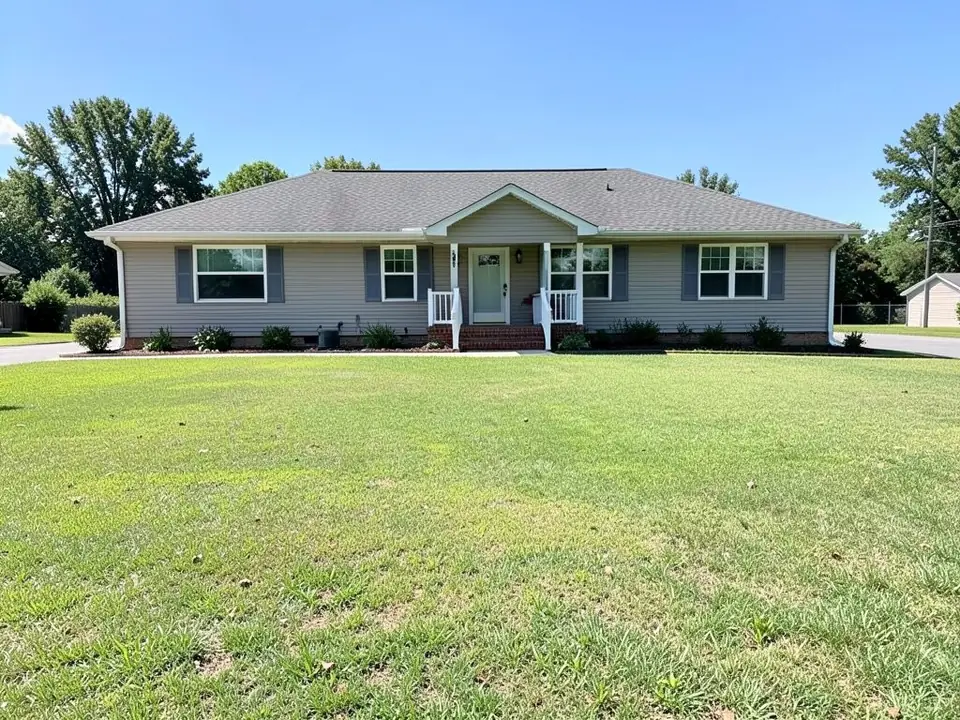
Why a ranch front can look flat, and what the sources do about it
A ranch house is one story with a long, low front, and the advice we read is mostly about softening that shape without hiding the house. The American Way Realty blog, from a real estate office in Mankato, Minnesota, says the goals are to visually raise the low profile and soften the square outline, that shrubs do most of that work, and that low shrubs keep the big front windows in view. ShrubHub, a landscape design service, says to break the yard into sections so it is not one flat stretch, to use curves to draw attention to the best features of the house, and to avoid large trees and dense clusters of plants that hide a low house.
Innovation Grounds, a Texas landscaping company, takes the other route and suggests designing to emphasize the width, with long, layered beds. Yardzen, a landscape design service, says the simple ranch layout works with almost any style, and its article shows ten, from a modern farmhouse yard with a split-rail fence and a decomposed granite path, to a dry meadow with large concrete pavers and gravel, to a traditional yard with foundation beds of hydrangeas and catmint and a curved stepping-stone path.
A wider, curved bed along the front
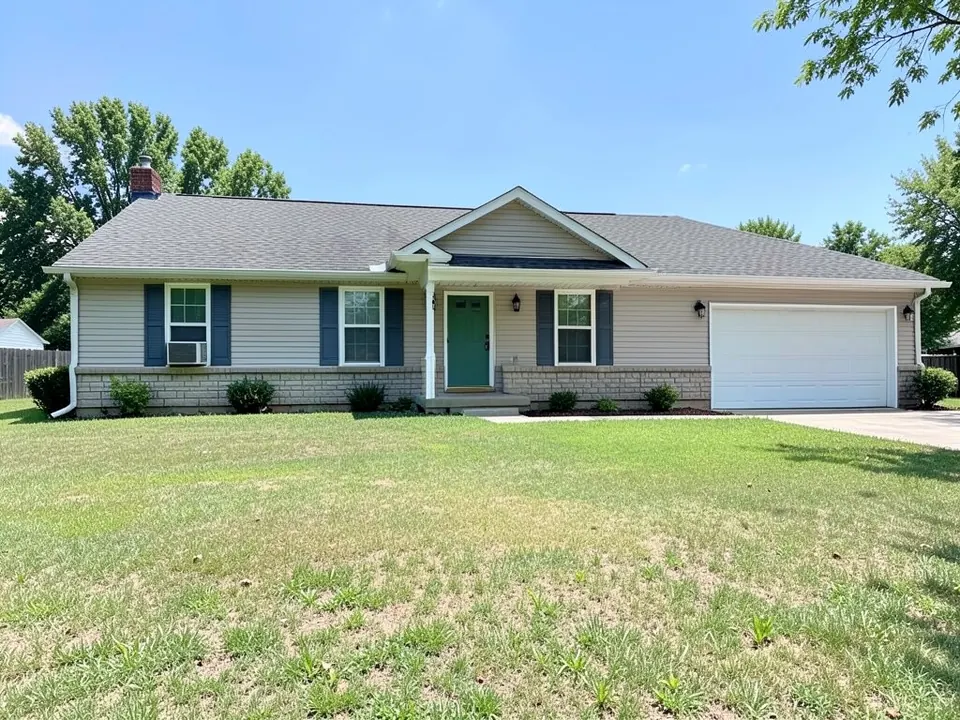
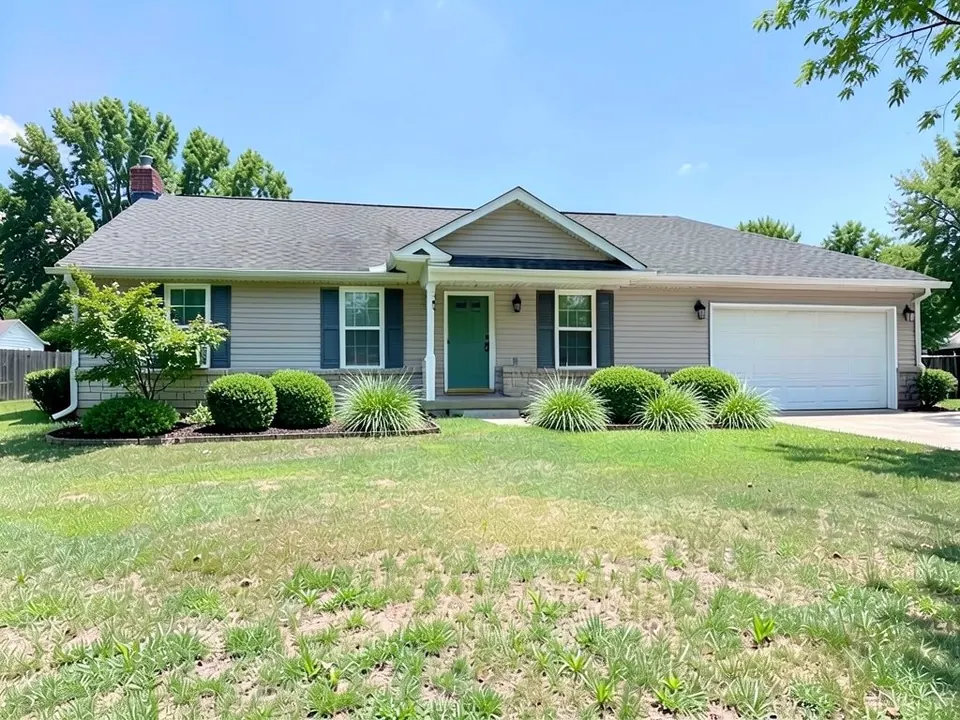
The foundation bed is where most of the sources start. Our first example adds one across a ranch front.
- Make it wider and curve it: American Way Realty says to make the front bed at least 4 feet wide and to curve it, with the curve centered on the middle of the front of the house. It also suggests raising the bed about 10 inches with topsoil so the eye moves up from the street.
- Low, rounded shrubs under the windows: American Way Realty suggests small, rounded shrubs, naming Winter Gem or dwarf English boxwood for the shade under the eaves, and box-leaf euonymus, prostrate white abelia and Cream De Mint dwarf mock orange as low shrubs set back from the bed edge. It notes these suit different USDA zones, so check yours.
- Something taller at the corners: American Way Realty suggests larger shrubs, such as azaleas, or a tall, conical tree at the corners of the house to end the long line and add a vertical point. It suggests an asymmetrical grouping, since ranch homes are meant to feel informal.
- Color and texture: American Way Realty suggests variegated or colored foliage, such as gold thread cypress, to draw the eye. ShrubHub suggests native plants and ornamental grasses at different heights in a loose, natural layout. Dundee Concrete & Landscaping, a Spokane contractor, says to layer taller plants at the back and shorter ones in front, and to use mulch at least 2 to 3 inches thick.
The entry and the walkway
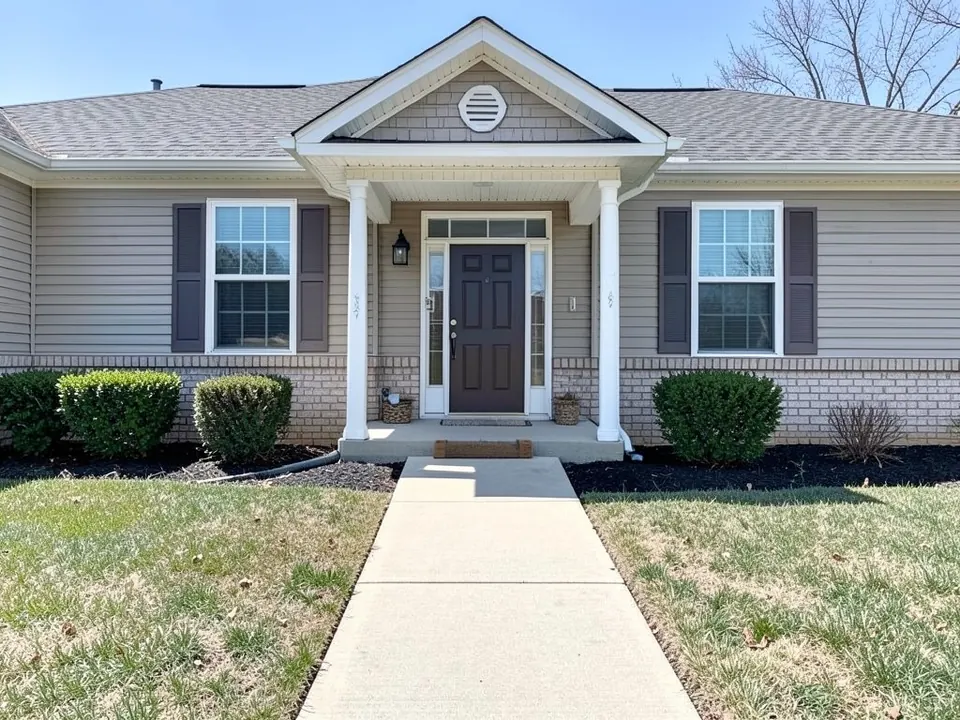
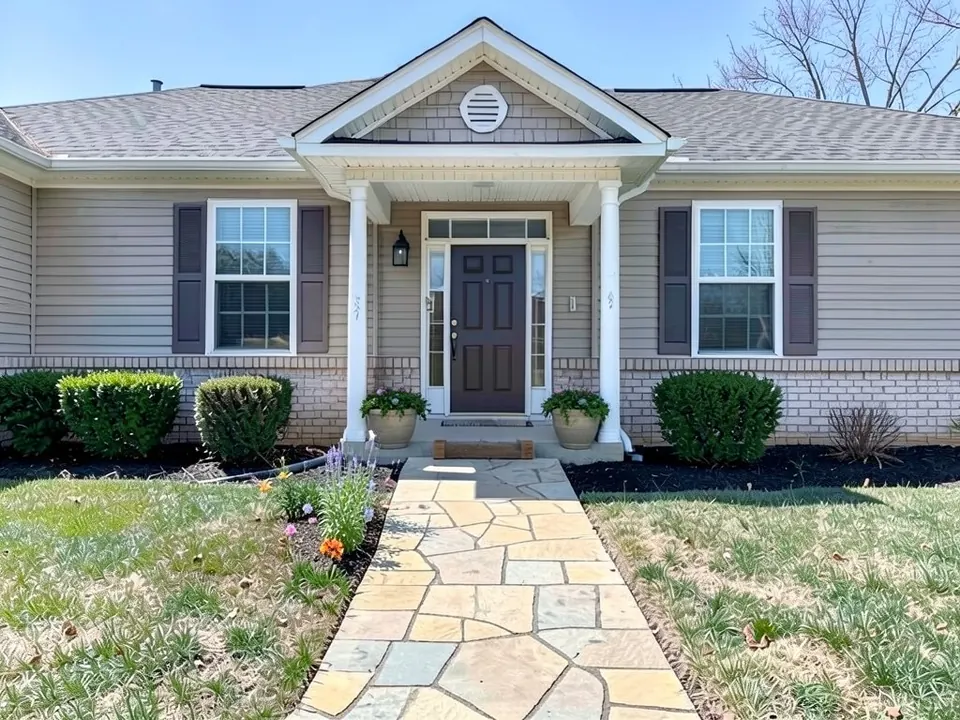
Many ranch houses have a short straight concrete walk to the door. Innovation Grounds suggests replacing plain concrete with natural stone, flagstone, brick or pavers, says curved paths soften the strong lines of the house, and suggests matching planters or shrubs on both sides of the door. Dundee Concrete & Landscaping suggests paving the path with flagstone or concrete pavers, planting flowers along the edges and adding path lights. ShrubHub suggests concrete slabs or pavers with pebbles or turf between them, and window boxes with colorful flowers near the low windows and the front door.
Our second example tries a flagstone path with pots by the door. For more walkway ideas, see our front walkway landscaping ideas page.
Trees on a big ranch lawn
Ranch houses often sit behind a wide lawn, and the sources pull in two directions on trees. ShrubHub warns that large trees will further hide a ranch house. American Way Realty suggests a tall, conical tree at the corners. Dundee Concrete & Landscaping names Japanese maple, magnolia, crepe myrtle and dogwood for curb appeal. Yardzen's Idaho example keeps the existing trees at the ends of the front and adds Eastern redbuds, and its Georgia example puts a seating area under an existing tree.
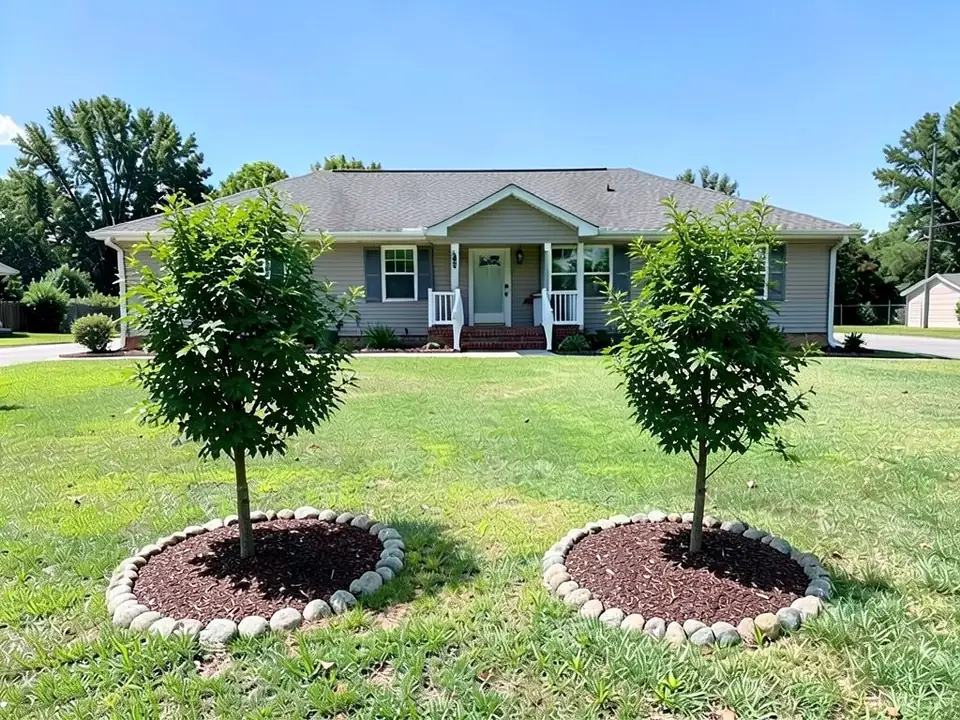
Our third example shows the risk ShrubHub describes: two trees placed in the middle of the lawn near the street hide much of the house. None of the pages we read gives a planting distance from the house for a ranch, so ask a local arborist or nursery where a tree should go. For beds around trees you already have, see landscaping around trees ideas.
How to try ranch house landscaping on your own photo
The tool above is already in Custom mode. The Yard Redesign styles have no text box, so you cannot name the bed, the shrubs or the path there. Custom lets you name them, say where they go, and say what must stay the same.
- Take the photo in daylight from the street or the end of the drive, with the whole front of the house, from one end to the other, in frame.
- Describe the change in the Custom Design Requirements box: the bed shape and how far it runs, the shrubs and grasses, any tree and where it stands, the path material, and what must stay the same, such as the house, the garage, the lawn and the camera angle.
- Upload your photo under Upload Your Garden Image and click Generate Custom Design. You sign in with an email code or Google when you generate.
- Compare the result with your photo, change one thing at a time, such as the bed or the tree position, and run it again. Short, specific instructions work better than long ones.
What the AI can and cannot do
The AI shows a look: roughly how a bed, shrubs, a path or a tree would sit in front of your own ranch house. That helps you choose and explain what you want to a landscaper or a nursery.
It does not measure the bed, does not know your climate, soil or sun, does not price anything and does not tell you how big a tree will grow or how far from the house it should go. It also does not always follow the instruction, as the bed that stops short, the path that stayed straight and the trees that hide the house in the examples above show. Treat the result as a picture of an idea, and get plant choices, sizes and spacing from a local landscaper or nursery.
Ranch house landscaping instructions to paste into Custom mode
These are the exact instructions we used for the three examples above, in the same order. In the tool above, Custom is already selected: paste one into the Custom Design Requirements box, then upload your photo. Swap in your own plants, path material, tree position and what must stay.
- Change ONLY the area along the front of the house: add a long planting bed across the full front with low rounded shrubs alternating with ornamental grasses, and one small tree near the left corner. Keep the house, the garage, the lawn and the camera angle exactly the same.
- Change ONLY the walk and the lawn beside it: replace the concrete walk with a gently curved flagstone path, add a planting bed of perennials along it, and put two large potted plants by the front door. Keep the house, the door and the camera angle exactly the same.
- Change ONLY the front lawn: add two medium trees, each in a round island bed with mulch and a ring of small stones. Keep the house, the rest of the lawn and the camera angle exactly the same.
Frequently asked questions
How do I make a ranch house look less flat?
The pages we read suggest a wider, curved foundation bed, low rounded shrubs under the windows and something taller at the corners (American Way Realty), breaking the yard into sections and using curves (ShrubHub), and long, layered beds that play up the width (Innovation Grounds). Our first example shows a long bed of shrubs and grasses.
How wide should the bed in front of a ranch house be?
American Way Realty says at least 4 feet, curved, and raised about 10 inches with topsoil. The other pages we read give no width, so check with a local landscaper for your house and plants.
What shrubs suit the front of a ranch house?
American Way Realty names Winter Gem or dwarf English boxwood, box-leaf euonymus, prostrate white abelia and Cream De Mint dwarf mock orange as low shrubs, and azaleas for the corners. It says to keep shrubs low enough that the front windows stay in view. Check each for your USDA zone.
Should I plant trees in front of a ranch house?
The sources differ. ShrubHub warns that large trees hide a ranch house, while American Way Realty suggests a tall, conical tree at the corners and Dundee Concrete & Landscaping names Japanese maple, magnolia, crepe myrtle and dogwood. Our third example shows how trees in the middle of the lawn can block the house.
What can I use instead of a plain concrete walk?
Innovation Grounds suggests natural stone, flagstone, brick or pavers and says curved paths soften a ranch's lines. Dundee Concrete & Landscaping suggests flagstone or concrete pavers with flowers along the edges, and ShrubHub suggests slabs or pavers with pebbles or turf between them.
Can the AI plan my ranch house landscaping?
No. It draws the look you describe on your photo. It does not measure, price, choose plants for your climate or decide where trees should go, and it does not always follow the instruction exactly, as the captions above show.
Do I need an account, and is it free?
Create a free account with an email code or Google to generate. You get 1 free render, and free renders carry a watermark. More renders and no watermark come with a paid plan.