
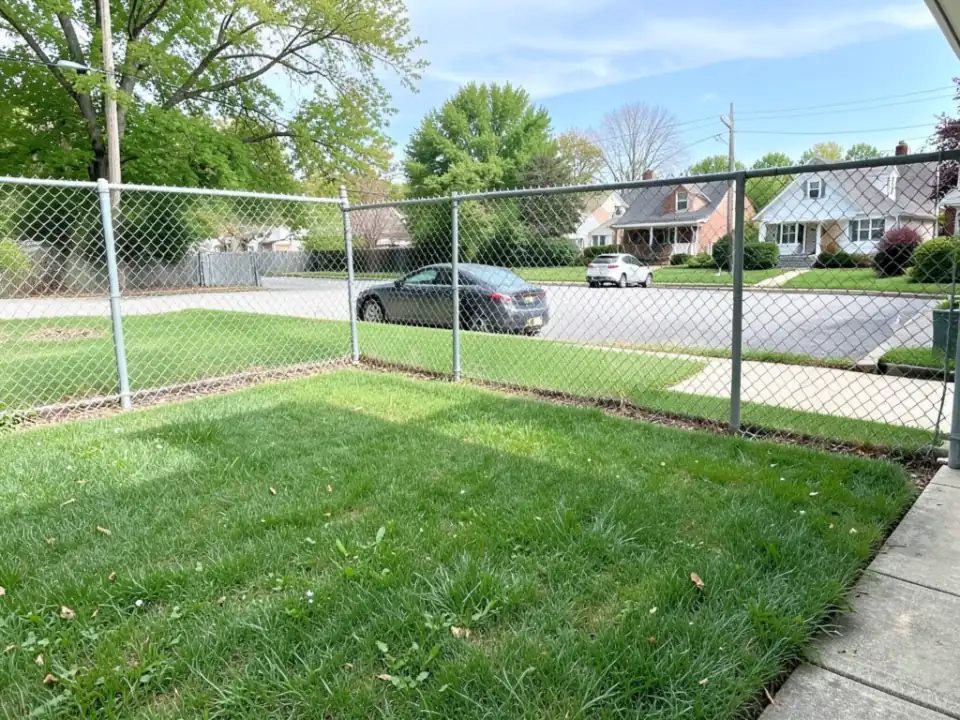
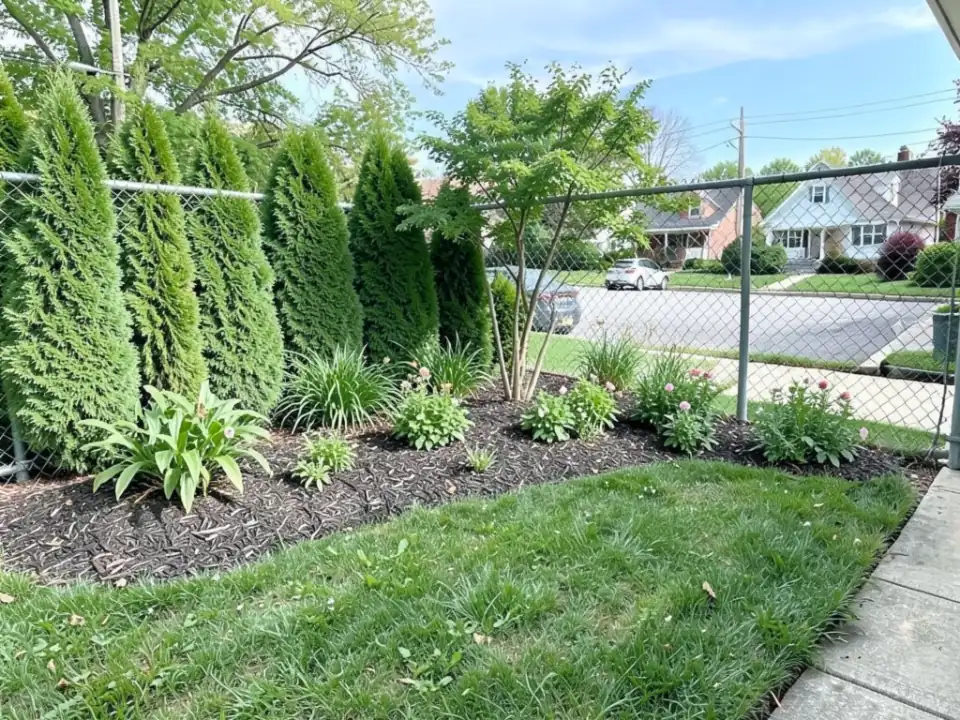
Start with the view you want to hide
Sit where you actually spend time, on the patio, at the table or in the hot tub, and look for what bothers you: a window, a road, a neighbor's deck. You rarely need a green wall around the whole lot. A few plants in the right spot often do more than a long hedge in the wrong one.
Notice the height of the view, too. Real Homes points out that a trellis with climbers screens people on your own level, but a window that looks down on you needs something that reaches higher. And keep expectations honest: Landscaping Network says none of these methods gives total privacy, so expect some trade-offs.
Privacy plants by type
- 1. An evergreen hedge: The classic along a property line. Bob Vila names arborvitae and privet among the most popular hedge plants, and notes that a long, tall hedge takes either a lot of money or a lot of time to establish and, depending on the plants, can need a fair amount of upkeep.
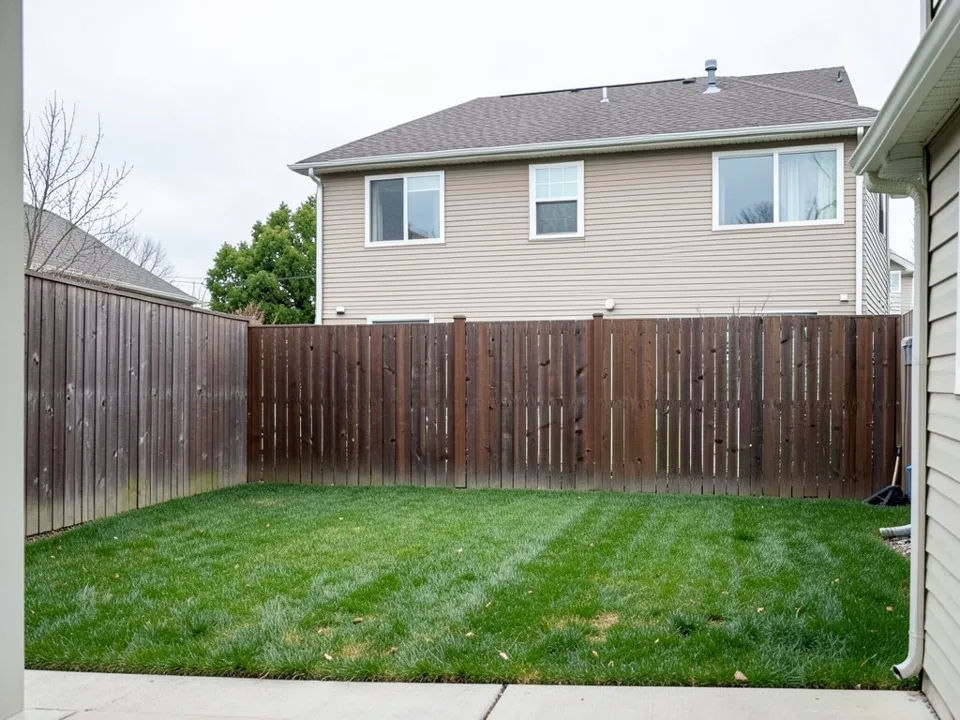
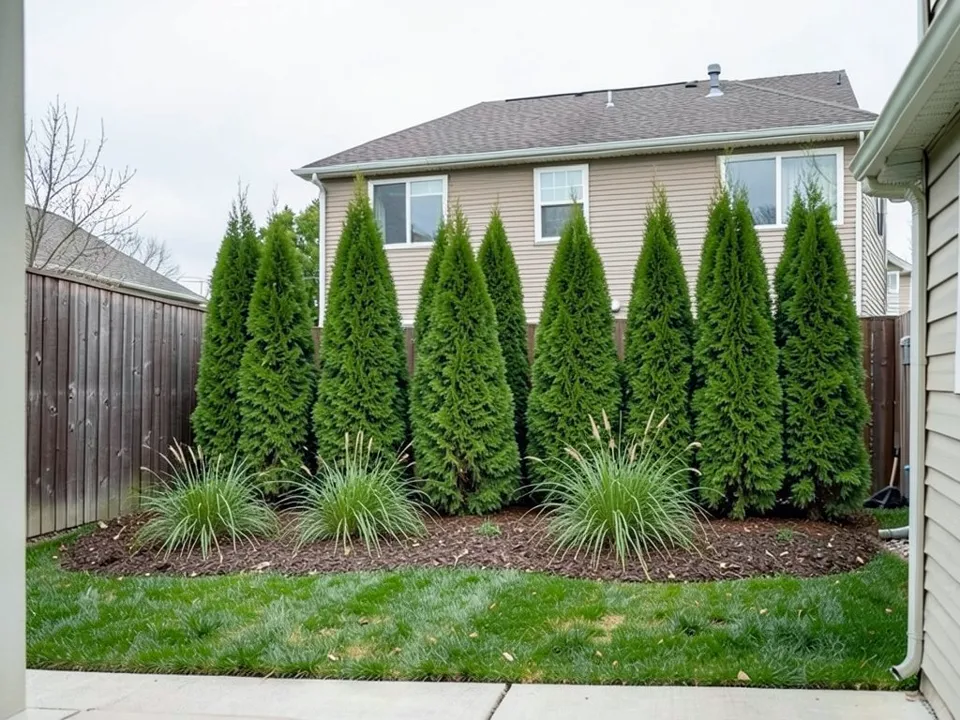
- 2. A staggered row of narrow trees: Columnar evergreens set in two offset rows close gaps sooner than a single straight line and take little lawn (our first example).
- 3. Tall ornamental grasses: Real Homes suggests grasses for city gardens. Many grasses are cut back in late winter or early spring, so expect a gap for part of the year.
- 4. Bamboo, with care: Fast and dense, but see the invasive plant warning below before you buy any.
- 5. Vines on the fence you already have: Climbers such as clematis or honeysuckle can add leafy height to a fence or trellis (Real Homes).
- 6. A layered border: Landscaping Network describes buffer planting: masses of trees and shrubs at different depths instead of one rigid line. Tom Clifford of Gardenstone, quoted by Real Homes, suggests placing trees, grasses or shrubs in front of a fence or hedge for extra screening and depth (our third example).
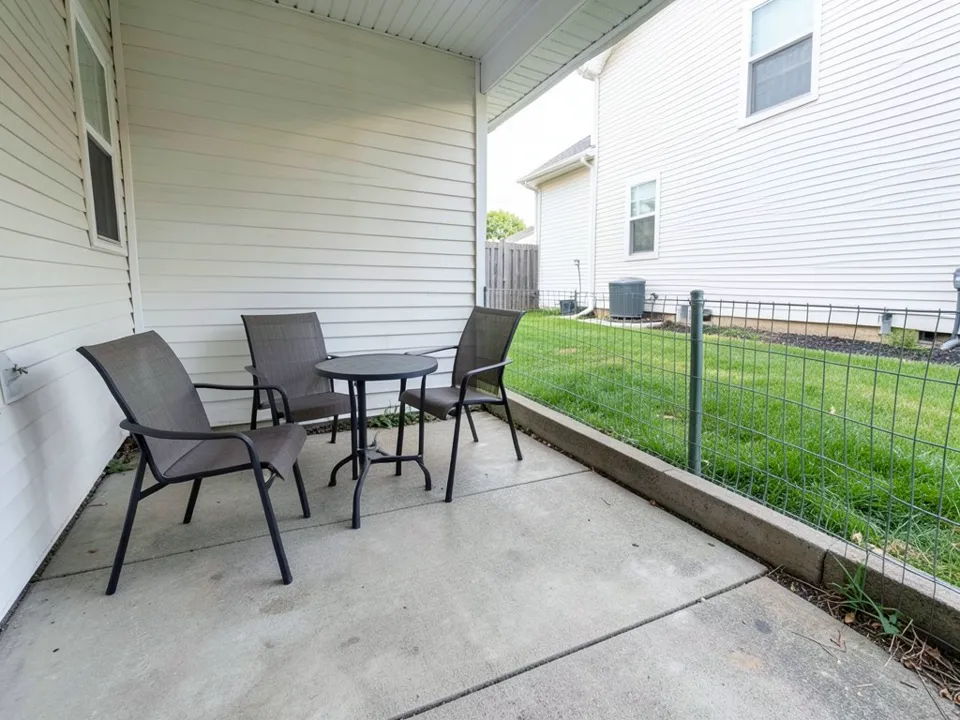
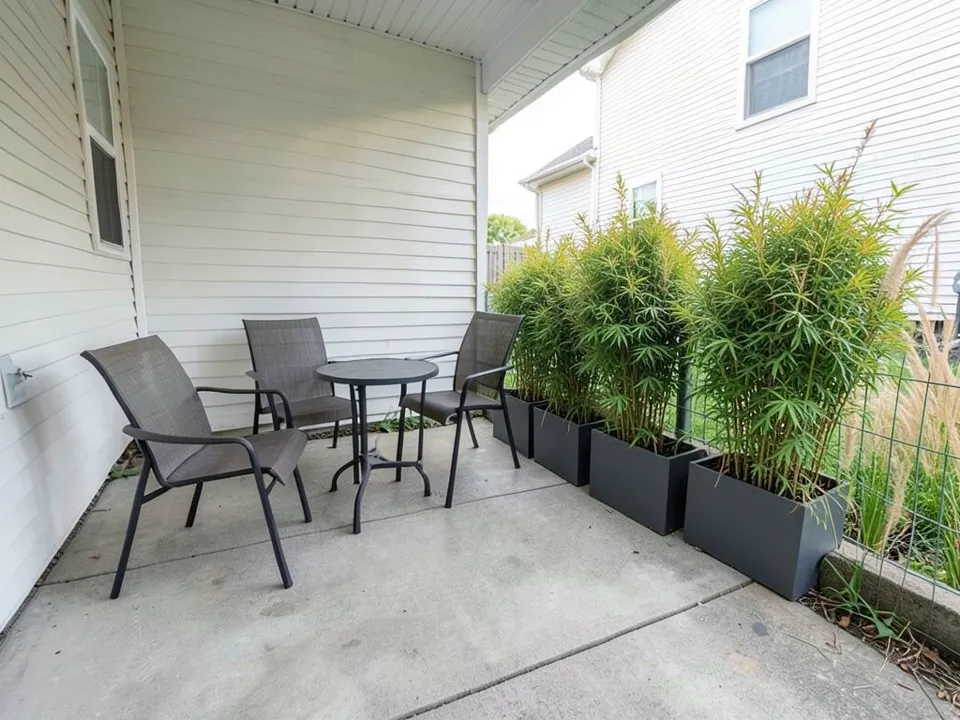
- 7. Tall planters: Planters screen a patio or balcony where there is no soil to plant in, and Bob Vila lists privacy screen planters among its ideas (our second example).
- 8. One tree in the right place: A single small tree between your seat and a neighbor's window can block more than a long hedge at the lot line.
Privacy ideas by situation
- Along a fence: Plant in front of the fence, not in place of it: evergreens or a mixed border inside the fence line, with grasses or perennials at the front.
- Small backyards: Choose narrow, upright plants, vines and planters; they take less ground than a wide hedge.
- Front yard without a fence: A deep curved bed of mixed shrubs and a small tree between the street and the front window gives privacy and still looks welcoming.
- Around a patio or hot tub: Screen only the sides that face a window or a road, with planters, grasses or a short run of hedge.
- From a neighbor's upstairs window: A hedge kept at fence height will not reach that high. A tree placed between the window and your seat does more; Real Homes notes that a roofed structure may be needed when you are overlooked from above.
- Along a road: Use the deepest layered planting you have room for, and remember that corner lots often have rules about plant height near the intersection.
Evergreen or deciduous?
For screening all year, use evergreens; Bob Vila and Real Homes both say so. Deciduous shrubs and trees still have a place: they add flowers and autumn color, and in a mixed border the evergreens keep the screen going in winter while the deciduous plants fill in during the months you spend outside.
Plan for the plant, not the picture
The AI draws plants as if they were already grown. Young plants from a nursery are much smaller, and a screen can take years to fill in. Treat the render as the goal, not as planting day.
Check the mature height and width on the plant tag or with your local nursery, space the plants by that width, and keep large trees away from foundations, as Real Homes advises. Landscaping Network lists shade, overhanging branches and upkeep among the things to weigh, and asks you to think about how your planting affects the neighbors and their views.
A plain warning about invasive plants
- Running bamboo: The University of Maryland Extension says several running bamboo species are invasive in the US and can spread into neighboring yards. It also says a pot is not a long-term fix for running bamboo, because the roots escape through drain holes and can break the container. Clumping bamboos, such as Fargesia, are considered non-invasive by the same source; if you want bamboo, start there and ask a local nursery what is hardy where you live.
- Privet: N.C. Cooperative Extension treats Chinese and Japanese privet as invasive plants and suggests replacements for hedges, including native wax myrtle and hollies.
- Check your own list: Rules differ by state and region. Before you buy, check your state invasive plant list or ask your county extension office.
Before you plant
- Call 811 (US): Have buried utility lines marked before you dig holes for trees or shrubs.
- Property line: Plant fully on your side, and leave room for the plants to grow without hanging over the line. If you are not sure where the line is, check your survey before planting.
- Local rules and HOA: Some towns and HOAs limit hedge or plant height, especially near corners and sidewalks. Check with your local building department or HOA before you plant a tall screen.
- Water and access: A new hedge needs regular watering while it settles in, so make sure a hose reaches it, and leave a path to trim the back.
Privacy plants and how big they get
The mature size on the plant tag matters more than how fast a plant grows. The plants below come from an article on evergreens for screening by Charlotte Glen of N.C. Cooperative Extension (NC State), written for gardens in the Southeast US. The sizes are her typical mature height and width. Your climate and the exact variety will change them, so ask your local extension office or nursery what grows well where you live.
Glen also suggests looking past Leyland cypress, which she calls disease-prone, and warns that fast-growing trees and shrubs are often weak-wooded and short-lived, so they can fail in storms or to disease.
- 'Emerald' arborvitae: Evergreen, about 15 feet tall and 3 to 4 feet wide. Narrow, for full sun, and prefers moist soil.
- 'Spartan' juniper: Evergreen, about 15 feet tall and 3 to 4 feet wide. Narrow, for full sun, and very drought tolerant.
- Hollies such as 'Nellie Stevens', 'Oakleaf' and 'Emily Bruner': Evergreen, 15 to 20 feet tall and 8 to 10 feet wide, with a moderate growth rate. Sun to part shade, well-drained soil, and red berries through fall and winter.
- Japanese plum yew 'Fastigiata': Evergreen, 10 to 12 feet tall and 6 to 8 feet wide. Columnar, grows in sun or shade, and is rarely bothered by deer.
- Cleyera: Evergreen, 10 to 15 feet tall and 6 to 8 feet wide. Glossy dark green leaves, sun or shade, drought tolerant.
- Fortune's tea olive: Evergreen, 15 to 20 feet tall and 10 to 15 feet wide. Sun or partial shade, with fragrant white flowers in fall. Good for a large, dense screen.
- 'Chindo' viburnum: Evergreen, 15 to 20 feet tall and 8 to 10 feet wide, and fast growing. Prefers moist, well-drained soil.
- Wax myrtle: Native evergreen, 8 to 10 feet tall and wide, and fast growing. It can break in heavy wind or ice but recovers quickly.
- 'Green Giant' thuja: Evergreen, 40 feet or more tall and 15 to 20 feet wide, and fast growing. Full sun. Glen notes it may be too big for a small lot.
How far apart to plant a privacy screen
Space plants for the size they will reach, not the size of the pot. Josh Fuder and Sheri Dorn of UGA Extension advise choosing the number of plants and their spacing from their mature size, and not planting right on the property line, because the grown plant will spread into your neighbor's yard.
Their example is Leyland cypress, which they say can grow 3 to 4 feet a year to about 50 feet tall and 30 feet wide and needs at least 15 feet between tree centers. Planted 4 to 5 feet apart for a quick screen, the trees shade each other and begin to thin and die back.
Mixing plants protects the screen. UGA Extension suggests alternating groups of three to five of one kind, so a problem with one plant does not run through the whole hedge. Oregon State University Extension gives the same advice and adds that, where you have room, two staggered rows improve air flow around the plants, which lowers humidity and disease while still giving a full screen.
Then be patient: Oregon State University Extension says it takes about 4 to 8 years to establish an effective hedge.
- Plant at the right depth: UGA Extension calls planting too deeply a leading cause of plant death, and says to dig the hole at least twice as wide as the root ball.
- Water the first year: The same UGA Extension article recommends at least 1 inch of water each week for the first year, applied slowly with a soaker hose or drip line.
- Clear the grass: Charlotte Glen of N.C. Cooperative Extension suggests removing grass from the planting area, since lawn competes with new shrubs for water and nutrients.
Screens and structures that work with plants
Plants are not the only way to block a view. A patio on concrete, a spot you need hidden this season, or a window that looks down on you can be easier to screen with a structure, or with a structure and plants together. LawnStarter lists several options that are not plants.
LawnStarter also points out the trade-off: a privacy fence needs less upkeep than a living barrier but costs more up front, while plants need watering, trimming and feeding. It describes pergola curtains, potted arborvitae and privacy screens as portable and inexpensive barriers, which helps when you rent or are on a tight budget.
Check height rules first. LawnStarter notes that each city has its own fence height rules, and an HOA can add more. Ask your building department or HOA before you add a tall screen, a fence topper or a roofed structure near the property line.
- Lattice or trellis: LawnStarter says a wood lattice fence lets you choose how much to hide, and its openings let wind pass through. Add climbers or pots to fill it in.
- Slatted privacy screen: A panel of horizontal slats beside a patio, pool or dining area, used alone or set around the space (LawnStarter).
- Curtains on a pergola, porch or gazebo: They add shade and seclusion, and you can open them when you want the view (LawnStarter).
- A roof over the seating area: The one option here that blocks a view from an upper-floor window, as both LawnStarter and Real Homes point out.
- Shelves or a living wall on a fence: LawnStarter suggests shelves, hanging plants or a living wall on an existing fence or wall to add height and screening.
How to try a privacy planting on your own photo
Use Custom mode for this. None of the Yard Redesign styles is aimed at screening a view, and that mode has no text box, so you cannot tell it where the screen should go. Custom lets you name the plants, the spot and what must stay the same.
- Take the photo from where you sit or stand when you feel watched, in daylight, with the view you want to block in frame.
- Open the landscape tool and sign in with Google or an email code. You get 1 free render with a free account.
- Under Select Landscape Mode, pick Custom.
- In the Custom Design Requirements box, describe the plants and where they go (along the back fence, beside the patio, between the street and the window), how tall they should look, and what must stay the same, such as the house, fence, patio and lawn.
- Upload your photo under Upload Your Garden Image and click Generate Custom Design.
- Compare the result with your photo, change one thing at a time and run it again.
What the AI can and cannot do
The AI shows a look: roughly how a hedge, a row of trees or a planted bed would sit in your yard and how much of the view it might cover, which helps you choose and explain what you want to a nursery or landscaper.
It is not a plan. It does not measure heights or distances, it does not know your climate, and it does not always follow the instruction: in all three examples above, the plants hide less of the view than we asked for. It usually keeps the house as it is, but it also changed things nobody asked for, such as the shape of the lawn and, in our third example, part of the fence and the camera angle. Check the result against your photo.
Privacy planting instructions to paste into Custom mode
These are the exact instructions we used for the three examples above, in the same order. In the landscape tool, choose Custom, paste one into the Custom Design Requirements box, then upload your photo. Swap in your own plants, the spot and what must stay.
- Plant a staggered double row of tall, narrow evergreen arborvitae trees in a mulched bed along the back fence, tall enough to hide the neighbor's upper windows, with clumps of ornamental grasses in front of them. Keep the wooden fence, the lawn, the patio edge, the house wall on the right, the sky and camera angle exactly the same.
- Along the low wire fence at the open side of the patio, set a row of tall rectangular dark gray planters filled with dense clumping bamboo and tall ornamental grasses that screen the view of the neighbor's house. Keep the patio, chairs, table, the house wall, the wire fence, sky and camera angle exactly the same.
- Plant a layered border in a long mulched bed that runs along the inside of the chain-link fence for its whole length: a back row of tall evergreen shrubs and a small multi-stem tree that hide the street and the parked car, medium flowering shrubs in front of them and low perennials at the front edge. Keep the chain-link fence, the lawn, the concrete path on the right, sky and camera angle exactly the same.
Frequently asked questions
What grows fastest for privacy?
Speed depends on the plant and your climate, so ask a local nursery for the fastest hedge plants that are not invasive where you live. Bob Vila names arborvitae and privet as popular hedge choices, but privet is invasive in parts of the US, and running bamboo spreads aggressively (University of Maryland Extension).
How do I get privacy along a fence?
Plant in front of it: a row of narrow evergreens, a layered border, or vines on the fence itself. Placing plants in front of a fence adds screening and depth, as Tom Clifford of Gardenstone tells Real Homes.
What works for privacy in a small backyard?
Narrow, upright plants, vines on the fence and tall planters. They block a view without eating the lawn or patio, and a single well-placed tree can matter more than a long hedge.
Can plants reduce noise?
A little. A thick, layered planting can soften some sound and hides its source, but leaves are no match for a solid wall, so do not expect a hedge to silence a busy road. Bob Vila also suggests a fountain to help mask conversation.
Should I use evergreen or deciduous plants for privacy?
Evergreens for year-round screening, as Bob Vila and Real Homes advise. A mix works well: evergreens keep the screen in winter while deciduous plants add flowers and color.
How do I get front yard privacy without a fence?
Use a deep bed of mixed shrubs and a small tree between the street and the windows you want to shield. Check local and HOA rules on plant height near sidewalks and corners first.
Does the render show the plants at full size?
Yes, the AI draws them as if they were already grown. New plants are much smaller and can take years to fill in, so check the mature size on the plant tag.
Do I need an account, and is it free?
You need an account, and it is free: 1 free render with a free account, and free renders carry a watermark. More renders and no watermark come with a paid plan.
What is a good privacy plant for shade?
Charlotte Glen of N.C. Cooperative Extension suggests Japanese plum yew 'Fastigiata', a columnar evergreen about 10 to 12 feet tall that grows in sun or shade, and cleyera, which grows 10 to 15 feet tall in sun or shade. Oregon State University Extension adds that yews tolerate sun and shade but not soggy soil, and that many viburnums are shade tolerant. Ask a local nursery which of these grow where you live.
How far apart should I plant privacy trees?
Space them by their mature width, not the pot size. UGA Extension advises choosing spacing from mature size and not planting right on the property line. Its example: Leyland cypress needs at least 15 feet between tree centers, and trees planted 4 to 5 feet apart begin to thin and die back.
How long does a privacy hedge take to fill in?
Oregon State University Extension says it takes about 4 to 8 years to establish an effective hedge. Our AI draws the plants as if they were already grown, so treat the render as the goal, not planting day.
Is Leyland cypress a good privacy tree?
Extension experts are wary of it. Charlotte Glen of N.C. Cooperative Extension calls it disease-prone and suggests other evergreens, and UGA Extension says it can reach about 50 feet tall and 30 feet wide, so it thins and dies back when planted close together for a quick screen.
More yard ideas
- Small backyard landscaping ideas
- Sloped backyard ideas
- Cottage garden ideas
- Small front yard landscaping ideas
- Backyard design ideas
- Side yard landscaping ideas
- Hot tub landscaping ideas
- Shed landscaping ideas
- Backyard fence ideas
- Front yard fence ideas
- Shade garden ideas
- Pergola ideas
- Corner lot landscaping ideas