
Where to put a rain garden
A rain garden is a shallow, planted dip that catches water from a roof, driveway or lawn and lets it soak in, usually within a day. It is not a pond or a water garden (UConn). Where you put it matters more than how it looks.
| Source | Septic | Well | Water table or bedrock |
|---|---|---|---|
| Wisconsin DNR (2018) | 5 ft | 8 ft | 1 ft above |
| NC Cooperative Extension | 25 ft from the drain field | 10 ft | – |
| Clemson (2016) | 25 ft from the drain field | – | No shallower than 18 in |
| UNL Extension | 25 ft | 25 ft | 2 ft below |
| UF/IFAS | 25 ft | 25 ft | – |
| UConn | Not over it | – | Bedrock: not closer than 2 ft |
| Iowa (2021) | 100 ft, downslope | 100 ft private, 200 ft public | – |
- Away from the house: At least 10 feet from the house, so the water does not seep into the foundation (Wisconsin DNR, Penn State, UNL, Clemson, UF/IFAS). Iowa's guide prefers 30 to 40 feet from a basement. Rutgers allows 2 feet for a house with no basement.
- Downhill, not uphill: Put it where water already flows away from the house, not uphill of the house, a septic system or a well (NC Cooperative Extension). Don't send the overflow back toward the foundation (UConn).
- Not where water already ponds: Wisconsin's 2003 manual says it is tempting, then: "Don't!" Wet patches show where water soaks in slowly, and a rain garden needs soil that soaks it in.
- Not under a big tree: Wisconsin's 2003 manual says roots make it hard to dig and the extra water could damage the tree; UNL says not directly beneath a tree canopy.
- On a gentle slope: Under about 12 percent is best (Wisconsin DNR, UNL); Penn State calls over 10 percent not ideal. On steeper ground, Wisconsin's 2018 guide suggests terraces or a landscape professional.
- Buried lines: Call 811 before you dig (Wisconsin DNR, UF/IFAS). UConn warns that 811 will not locate small lines such as wires to outdoor lights, and Iowa adds private lines such as electric dog fences.
- Sun: NC Cooperative Extension says partial to full sun, at least 4 hours a day. Clemson says shady rain gardens work too, with shade plants.
- Walk it in the rain: Penn State's tip: walk the yard during a storm and watch where the water goes.
How big to make a rain garden
Size comes from the area that drains into the garden and from how fast your soil drains. First find the drainage area: for a downspout, the part of the roof that drains to it. Wisconsin's example is a 60 by 40 foot roof (2,400 sq ft) with a downspout taking a quarter of it, so 600 sq ft.
Then multiply by the sizing factor from the table. Wisconsin's example: 600 sq ft, silty soil, 6 inches deep and under 30 feet from the downspout, so 600 × 0.30 = 180 sq ft. At 10 feet wide that is 18 feet long.
| Depth / distance | Sandy (over 1.0) | Silty (0.41–1.0) | Clayey (0.15–0.40) |
|---|---|---|---|
| 3–5 in deep, under 30 ft from downspout | 0.17 | 0.35 | 0.44 |
| 6–7 in deep, under 30 ft | 0.13 | 0.30 | 0.35 |
| 8 in deep, under 30 ft | 0.11 | 0.23 | 0.25 |
| Over 30 ft from downspout, any depth | 0.03 | 0.08 | 0.10 |
Simpler rules give other answers: Penn State says 10 to 20 percent of the hard surface draining to it. UConn says a typical home rain garden is 50 to 100 sq ft; Wisconsin's 2003 manual says 100 to 300 sq ft. If the number is too big for your yard, Wisconsin's 2003 manual says a garden up to 30 percent smaller still controls almost 90 percent of the runoff, and bigger is fine too.
Shape: about twice as long as it is wide, with the long side across the slope so water spreads along it (Wisconsin DNR 2003). Crescent, kidney and teardrop shapes all work.
How deep to dig a rain garden
Most guides say 4 to 8 inches of ponding depth (Wisconsin DNR 2003, UNL, UF/IFAS); Wisconsin's 2018 guide says 3 to 8. Deeper holds water too long and looks like a hole; UF/IFAS says anything deeper could become a breeding ground for mosquitoes. The bottom should be level, so on a slope you dig more on the uphill side and use the soil to build a low berm on the downhill side.
| Slope | Depth |
|---|---|
| Under 4% | 3 to 5 in |
| 5 to 7% | 6 to 7 in |
| 8 to 12% | About 8 in |
| Over 12% | Pick another spot (2003) or ask a professional (2018) |
That is the depth of the water, not of the hole. NC State's guide says to dig the ponding depth plus 3 inches for mulch.
Test how fast your soil drains
Dig a test hole where the garden will go, fill it with water, and time it. The guides use different holes and pass lines:
- Wisconsin DNR (2003): Dig a hole 6 to 12 inches deep, fill it with water and let it soak for an hour, then refill it and measure the water with a ruler. If it drops more than half an inch in one hour, the site should be suitable. Half an inch or less: pick another site.
- NC State (NC WRRI): Dig a hole 24 inches deep and 12 inches wide and fill it with water. If it takes more than 36 hours to drain, the site is not right for a rain garden. If you hit groundwater while digging, it is not right either.
- Iowa (2021): Over half an inch per hour works for a basic rain garden.
- Clemson (2016): A drop of 1 to 6 inches in the first hour is ideal. If the hole has not drained in 24 hours, Clemson suggests a bog garden or backyard wetland instead.
- UNL: Soil should take in at least a quarter inch per hour.
Soil, mulch and where the water goes in and out
- Soil: Wisconsin's 2018 guide works about 2 inches of compost into the top 4 to 6 inches. NC State says at least 25 percent amendment. Clemson's mix is 50 to 60 percent sand, 20 to 30 percent topsoil and 20 to 30 percent compost.
- Mulch: Shredded hardwood: 2 to 3 inches (Penn State), about 3 inches double-shredded (Wisconsin DNR 2003), 3 to 4 inches (Clemson). Penn State says to avoid dyed mulch and too much mulch, which can float away in storms. Clemson suggests cedar over cypress and avoids pine straw and pine bark.
- Inlet: Line where the water comes in with rock so it does not wash out the bed: NC State says you can use rocks to channel water from the downspout, and Iowa uses 3 to 4 inch rock at the inlet and outlet. UConn says stones there slow the water down.
- Berm and overflow: On a slope, a low berm on the downhill side holds the water level. Big storms will overflow it, so plan where: NC Cooperative Extension makes a 1-foot-wide low spot (a weir) in the berm, and Clemson reinforces that dip with river rock. Wisconsin's 2018 guide stabilizes the opening with gravel.
Plants for a rain garden
Rain garden plants handle both wet spells and dry ones (Clemson). Most guides use native perennials, grasses and sedges. Wisconsin's 2018 guide says to plant each kind in groups of 3 to 7, mix bloom times, heights and textures, and include sedges and grasses with the flowers. Wisconsin's 2003 manual sets plants 1 foot apart in a grid; Iowa uses 12 inches.
UNL says to avoid trees in most cases. For shade, Clemson notes shady rain gardens work with shade plants.
Ask your local extension office for a native plant list for your area; the right plants differ a lot between, say, Wisconsin and Florida.
Mosquitoes and how long water should stand
A working rain garden does not breed mosquitoes. Mosquitoes need 7 to 12 days of standing water to lay and hatch eggs (Wisconsin DNR); Clemson says 7 to 10 days, NC Cooperative Extension about a week. A rain garden should be dry long before that.
| Source | Drain time |
|---|---|
| UConn | About 6 hours is typical |
| Iowa (2021) | 12 hours or less: rain in the afternoon, no standing water by morning |
| Wisconsin DNR (2003) | Not more than a day |
| Penn State | 12 to 24 hours, never more than 48 |
If water stands longer, the soil is too slow or packed down; Wisconsin's 2003 manual suggests leaving a temporary gap in the berm for the first year or two until the garden drains in under a day.
Looking after a rain garden
- First weeks: Water new plants for the first few weeks until they settle in (Wisconsin DNR 2003).
- First two seasons: Weed regularly; weeding time drops as the plants fill in (Wisconsin DNR 2003, Penn State).
- Each spring: Leave stems and seed heads over winter for birds. When new growth is 4 to 6 inches tall, cut back the old stems (Wisconsin DNR 2003); the 2018 guide cuts them to 6 to 8 inches.
- Mulch: Top up while the plants fill in. Penn State says an established garden does not need mulch every year, because the plants shade the soil.
- Winter: Don't pile shoveled snow on it: Penn State says snow piles carry road salt, sand and oil that can damage plants and soil.
What a rain garden costs
| Source | Cost |
|---|---|
| Wisconsin DNR (2003) | $3 to $5 doing it yourself with bought prairie plants; $12 to $15 with a landscaper |
| Rutgers | $3 to $5 |
| Iowa (2021 materials) | $4 to $10 for a basic do-it-yourself garden under 400 sq ft |
| UConn | Plants alone about $1 to $2 |
So a 180 sq ft garden like Wisconsin's example comes to roughly $540 to $1,800 doing it yourself, more with a landscaper. Plants shared by neighbors cut that a lot.
How to try a rain garden on a photo of your yard
- Take a photo of the spot from where you would normally see it, in daylight, with the downspout or the low area in frame.
- Open the landscape tool, choose Custom, and paste one of the instructions below into the Custom Design Requirements box.
- Change the plants, the shape and what must stay, then generate.
- If it misses something, as every one of our examples did, reword that part and run it again. Our AI kept putting gardens against the house, so say plainly where it must not go.
The picture shows the look and roughly where the garden would sit. It does not measure slope, depth or drainage, so plan those with the tables above.
Rain garden instructions to paste into Custom mode
These are the exact instructions we used for the examples above, in the same order. In the landscape tool, choose Custom, paste one into the Custom Design Requirements box, then upload a photo of your yard. Swap in your own plants, shape and what must stay.
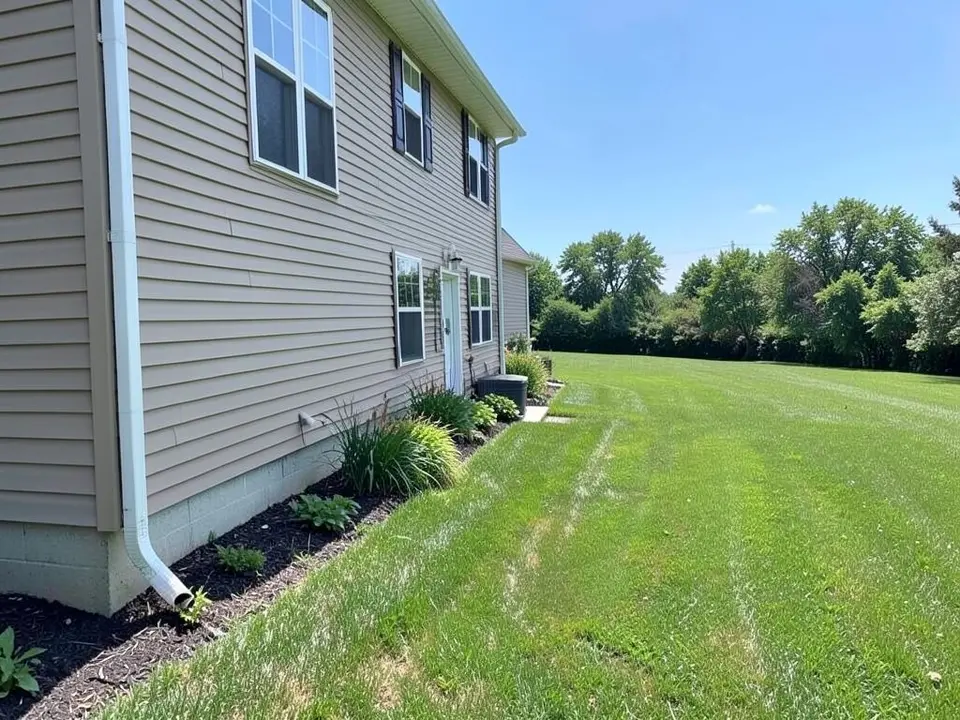
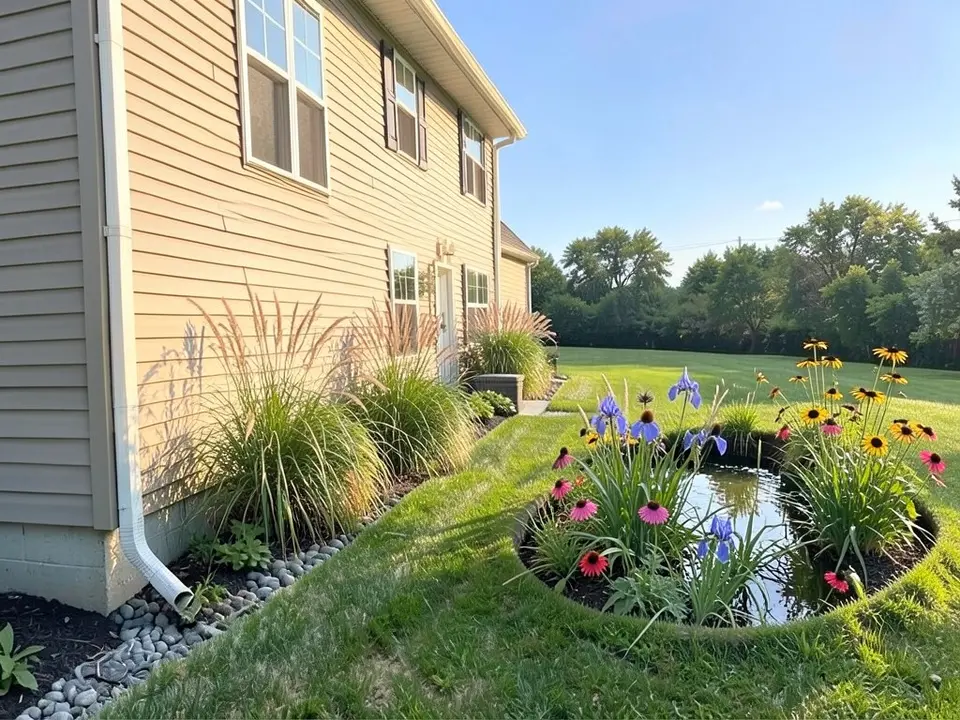
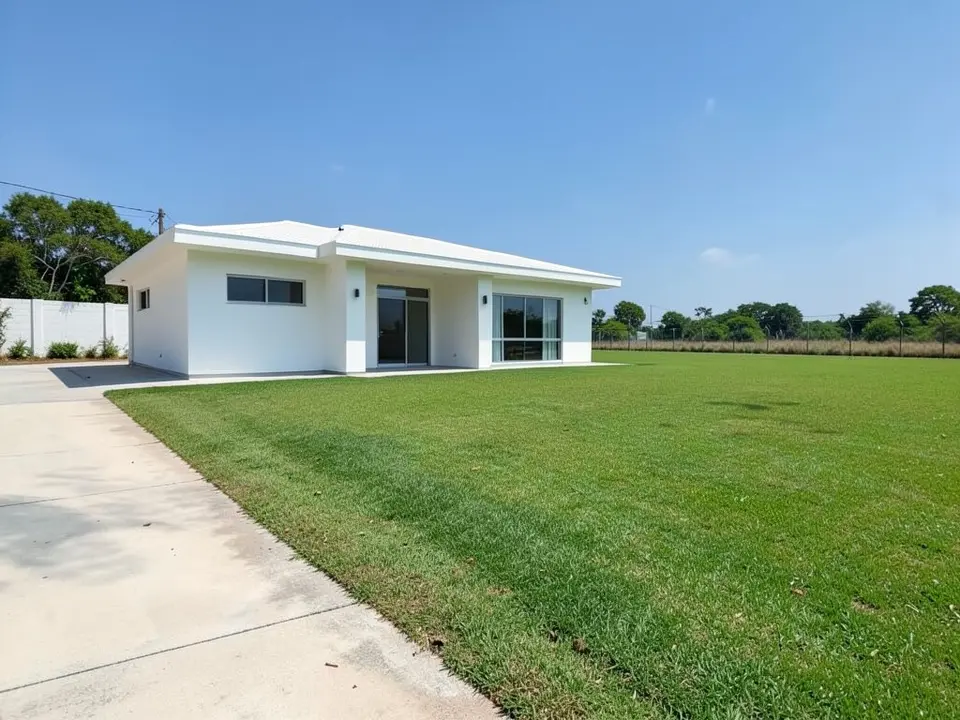
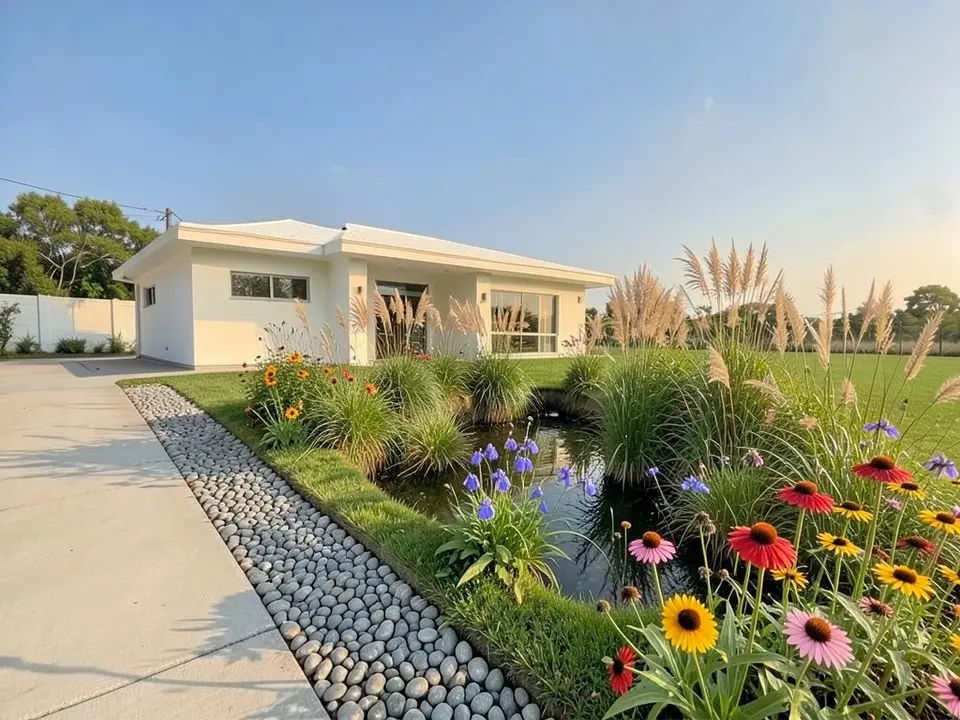
- Leave the grass along the house wall plain, nothing planted against the house. In the foreground, a wide, clearly visible channel of rounded grey river cobbles starts at the bottom of the white downspout and runs straight out across the green lawn toward the right, about fifteen feet, and spills down into a large oval rain garden out in the open lawn on the right side of the picture. The rain garden is a shallow hollow dug down into the lawn, like a wide shallow bowl in the ground: the grass slopes gently DOWN into it, so the plants grow from a floor clearly lower than the lawn. No raised edge, no wall. It has just rained: a small shallow pool of clear water shows only in the very centre of the hollow, mostly hidden by plants. The plants fill almost the whole hollow, dense and overflowing: big clumps of tall feathery switchgrass, sedges, tall blue flag iris, masses of purple coneflowers, golden black-eyed Susans, pink swamp milkweed and red cardinal flowers in full bloom, magazine-quality garden photo in golden afternoon light. Keep the house, the camera angle and everything else exactly the same. No people.
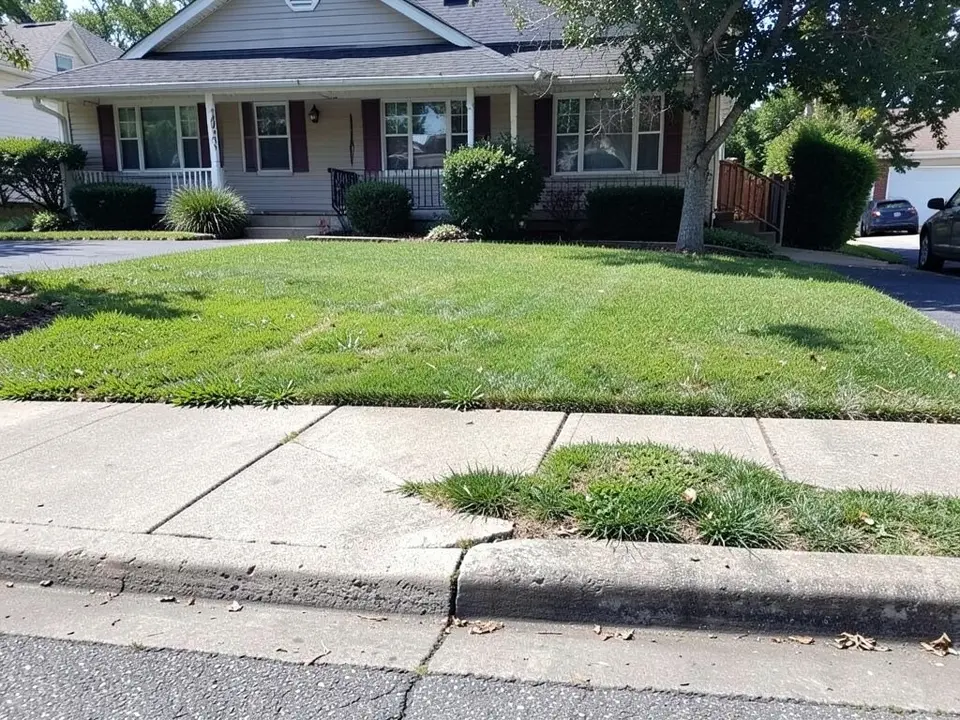
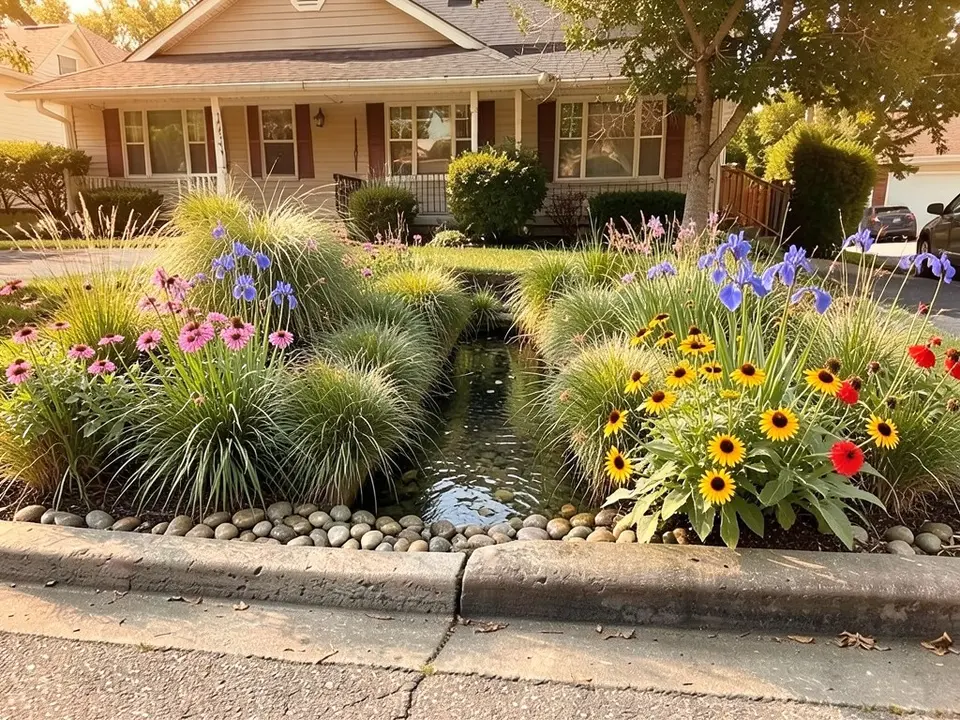
- Turn the grass strip between the sidewalk and the curb into a long rain garden. Its floor is dug down below the sidewalk and the top of the curb, with the soil sloping down from both edges, so it is clearly lower than the sidewalk. Where water comes in from the street there is a short gap in the curb lined with rounded river cobbles. It has just rained: a small shallow pool of clear water shows only in the very centre of the strip, mostly hidden by plants. The plants fill almost the whole strip, dense and overflowing: big clumps of knee-high feathery grasses, sedges, tall blue flag iris, masses of purple coneflowers, golden black-eyed Susans, pink swamp milkweed and red cardinal flowers in full bloom, magazine-quality garden photo in golden afternoon light. Keep the house, the camera angle and everything else exactly the same. No people.
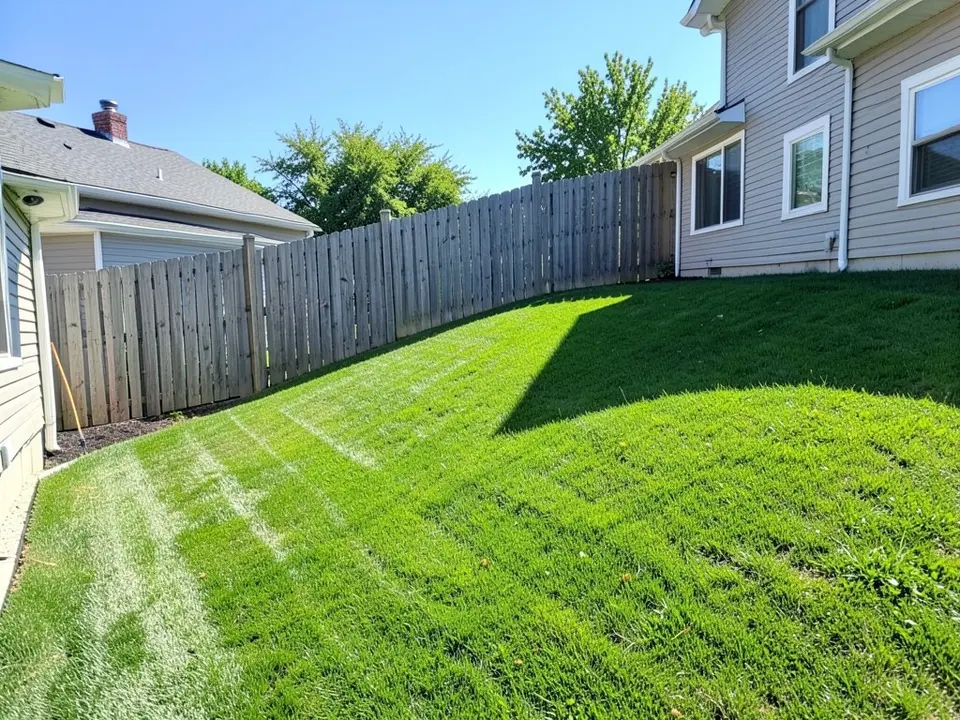
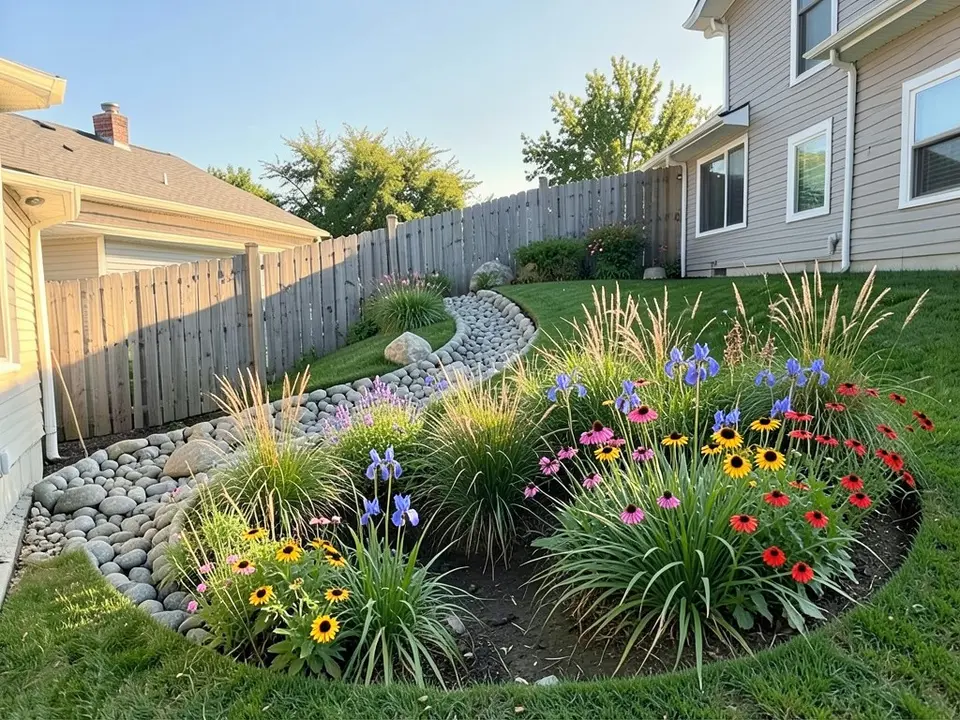
- Add a dry creek bed: a winding band of rounded grey river cobbles with a few larger boulders along its edges, about two feet wide, set into the lawn. It starts near the house at the top of the slope and winds down across the grass to a large oval rain garden in the low foreground of the picture. The creek is completely DRY: only dry pale grey stones, no water in it at all, no stream, no waterfall. The cobbles end where the creek meets the rain garden. The rain garden: It is a shallow hollow dug down into the lawn, like a wide shallow bowl in the ground: the grass slopes gently DOWN into it from every side, so the plants grow from a floor clearly lower than the lawn around it. There is no raised edge, no wall, no curb and no ring of stones around it; plain grass meets the plants directly. Plants cover the entire floor of the hollow from edge to edge, so thick that no soil, no water and no open centre can be seen: big clumps of tall feathery switchgrass, sedges, tall blue flag iris, masses of purple coneflowers, golden black-eyed Susans, pink swamp milkweed and red cardinal flowers in full bloom. No pond, no pool, no water anywhere. Magazine-quality garden photo in golden afternoon light. Keep the house, the fence, the camera angle and everything else exactly the same. No people.
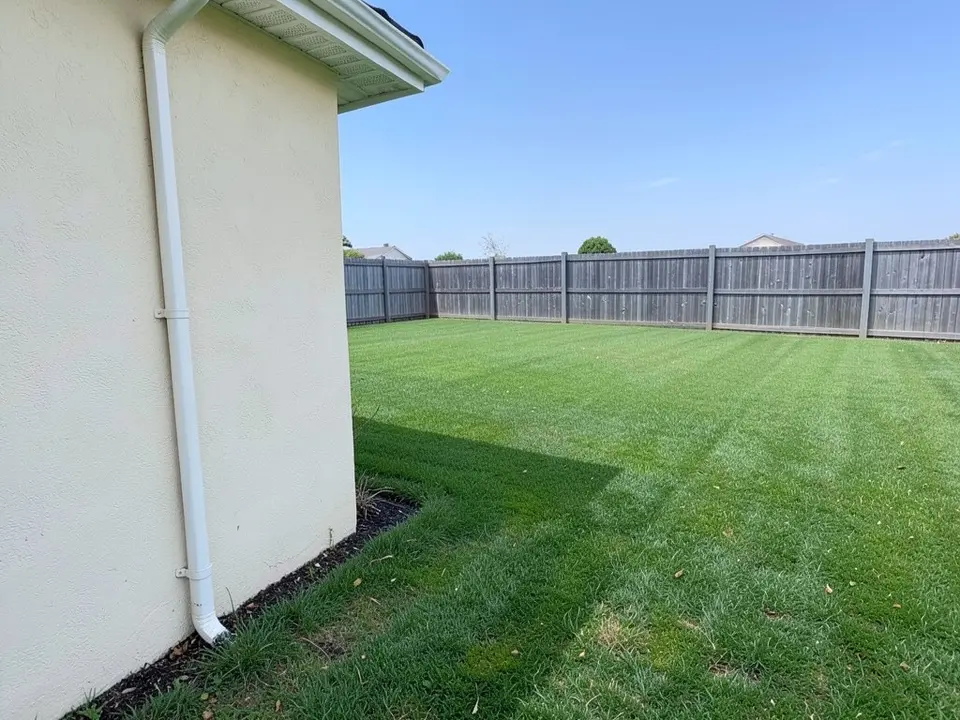
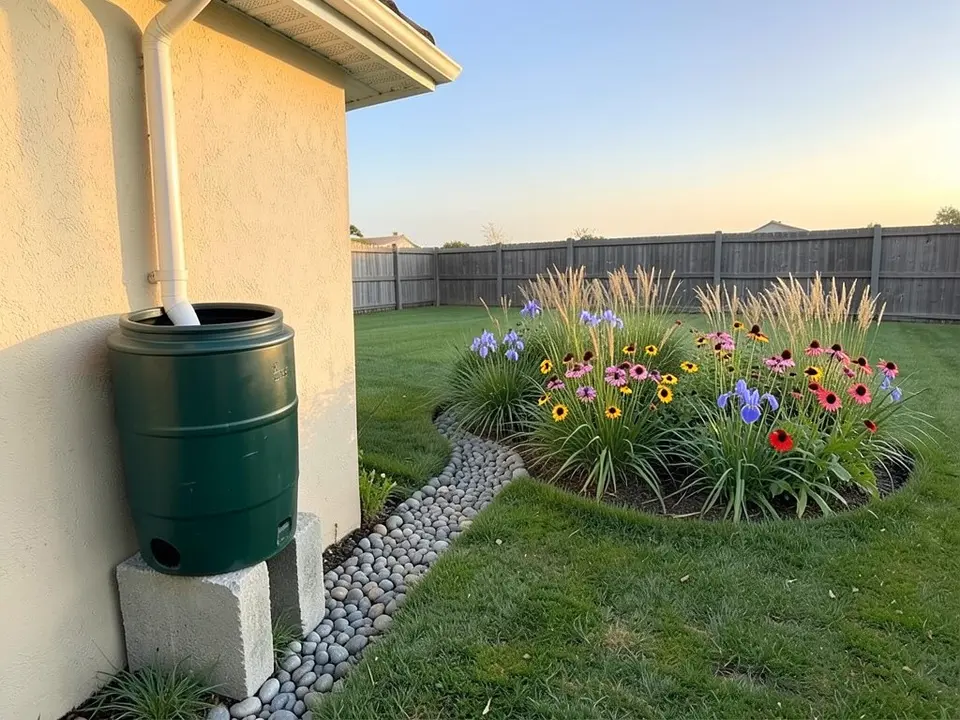
- Add a dark green plastic rain barrel, about waist high, standing on two grey concrete blocks against the house wall. The white downspout is cut short and ends directly into the open top of the barrel, so the roof water clearly goes into the barrel. The grass along the house wall stays plain lawn; nothing else is planted or built against the house. From the foot of the barrel a narrow channel of rounded grey river cobbles turns away from the house at once and runs diagonally out across the open lawn toward the fence at the back, never along the wall, about twenty feet long, and ends at a large oval rain garden in the middle of the lawn, halfway to the fence, with a wide stretch of plain grass between the house and the garden. The rain garden: It is a shallow hollow dug down into the lawn, like a wide shallow bowl in the ground: the grass slopes gently DOWN into it from every side, so the plants grow from a floor clearly lower than the lawn around it. There is no raised edge, no wall, no curb and no ring of stones around it; plain grass meets the plants directly. Plants cover the entire floor of the hollow from edge to edge, so thick that no soil, no water and no open centre can be seen: big clumps of tall feathery switchgrass, sedges, tall blue flag iris, masses of purple coneflowers, golden black-eyed Susans, pink swamp milkweed and red cardinal flowers in full bloom. No pond, no pool, no water anywhere. Magazine-quality garden photo in golden afternoon light. Keep the house, the fence, the camera angle and everything else exactly the same. No people.
- Keep the concrete driveway on the left completely clear, dry and unchanged. Out in the middle of the front lawn add one long, gently curved rain garden. A strip of rounded grey river cobbles runs from the edge of the driveway across the grass and spills down into the rain garden. The rain garden is a shallow hollow dug down into the lawn, like a wide shallow bowl in the ground: the grass slopes gently DOWN into it, so the plants grow from a floor clearly lower than the lawn. No raised edge, no wall. It has just rained: a small shallow pool of clear water shows only in the very centre of the hollow, mostly hidden by plants. The plants fill almost the whole hollow, dense and overflowing: big clumps of tall feathery switchgrass, sedges, tall blue flag iris, masses of purple coneflowers, golden black-eyed Susans, pink swamp milkweed and red cardinal flowers in full bloom, magazine-quality garden photo in golden afternoon light. Keep the house, the camera angle and everything else exactly the same. No people.
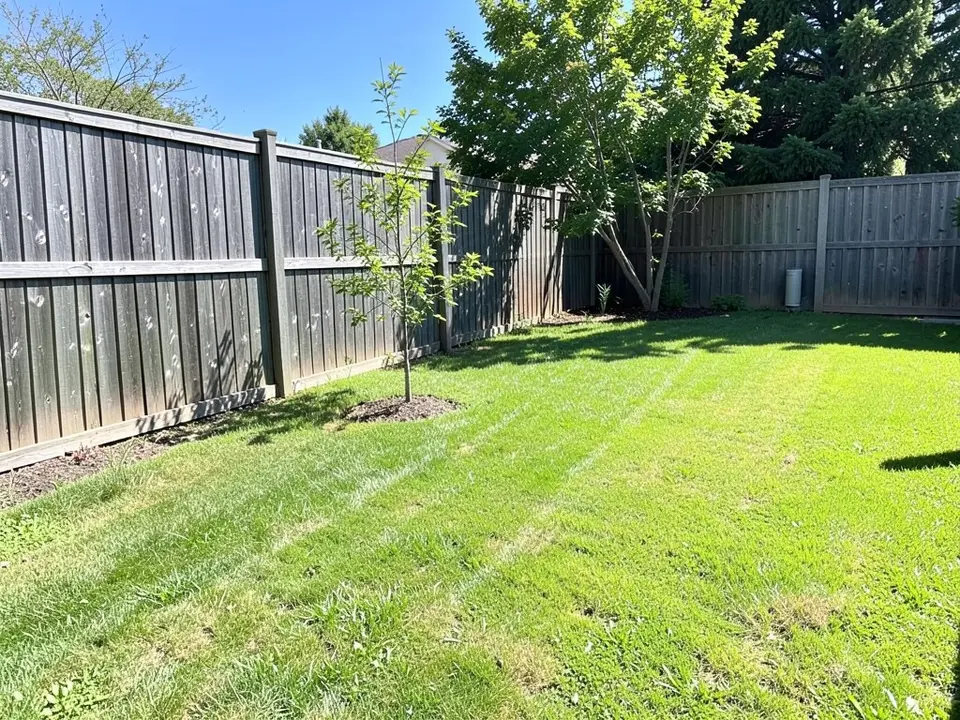
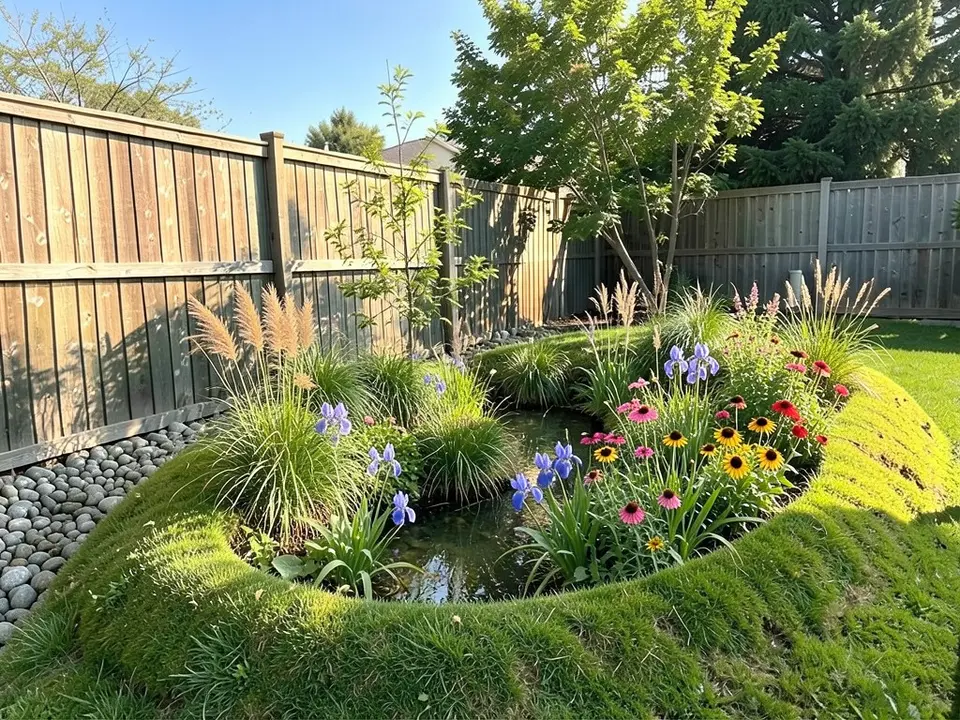
- Add a large curved rain garden across the slope. A channel of rounded grey river cobbles comes down the slope from the upper left and spills down into it. The rain garden is a shallow hollow dug down into the lawn, like a wide shallow bowl in the ground: the grass slopes gently DOWN into it from every side, so the plants grow from a floor that is clearly lower than the lawn around it. There is no raised edge, no wall and no curb around it; the lawn simply dips down into it. On the downhill side only, the lawn rises into a low, soft, gently rounded grassy mound of earth that holds the water in. It has just rained: a small shallow pool of clear water shows only in the very centre of the hollow, mostly hidden by plants, while the lawn around it is higher and dry. The plants fill almost the whole hollow, dense and overflowing like a mature English cottage border: big clumps of tall feathery switchgrass, soft green sedges, tall blue flag iris, masses of purple coneflowers, golden black-eyed Susans, pink swamp milkweed and red cardinal flowers in full bloom, almost no mulch visible, magazine-quality garden photo in golden afternoon light. Keep the house, the camera angle and everything else exactly the same. No people.
Rain garden questions
How far from the house should a rain garden be?
At least 10 feet, so water does not seep into the foundation (Wisconsin DNR, Penn State, UNL, Clemson, UF/IFAS). Iowa prefers 30 to 40 feet from a basement. Rutgers allows 2 feet for a house without a basement.
How big should a rain garden be?
Multiply the area that drains to it by a sizing factor for your soil and depth. In Wisconsin's example, 600 sq ft of roof on silty soil at 6 inches deep gives 600 × 0.30 = 180 sq ft. Penn State's simpler rule is 10 to 20 percent of the hard surface draining to it.
How deep should a rain garden be?
Usually 4 to 8 inches of ponding depth (Wisconsin DNR, UNL, UF/IFAS): about 3 to 5 inches on flat ground, up to about 8 inches on an 8 to 12 percent slope. Dig about 3 inches more for mulch.
Do rain gardens attract mosquitoes?
Not when they drain properly. Mosquitoes need 7 to 12 days of standing water to lay and hatch eggs (Wisconsin DNR), and a rain garden should drain in about a day or less.
Can I put a rain garden where water already pools?
Usually not. Wisconsin's 2003 manual says wet patches show where water soaks in slowly. Do a drainage test first; if the hole has not drained in 24 hours, Clemson suggests a bog garden instead.
What should I plant in a rain garden?
Native perennials, grasses and sedges that handle wet and dry spells, in groups of 3 to 7 (Wisconsin DNR). Use shade plants such as ferns, hostas and sedges in shade. Ask your local extension office for a native plant list.
How much does a rain garden cost?
About $3 to $5 per square foot if you do it yourself (Wisconsin DNR, Rutgers), $4 to $10 for materials in Iowa's 2021 guide, and $12 to $15 with a landscaper (Wisconsin DNR, 2003).
Can I see a rain garden on a photo of my own yard?
Yes. Upload a photo to the landscape tool, choose Custom, and describe the garden: its shape, plants, where it sits and what must stay. The result is a picture for planning, not a measured plan.
Is the rain garden tool free?
You need an account, and it is free: 1 free render with a free account (sign in with Google or an email code). More renders come with a paid plan.
Sources for the rain garden facts
- Wisconsin DNR and Standards Oversight Council, Rain Gardens: A Guide for Homeowners and Landscapers (2018, PDF)
- University of Wisconsin-Extension and Wisconsin DNR, Rain Gardens: A how-to manual for homeowners (2003, PDF)
- Penn State Extension, Best practices for rain gardens
- Penn State Extension, How to make a rain garden
- Clemson Extension, Carolina Clear rain garden manual (2016, PDF)
- NC Cooperative Extension, Backyard rain garden manual (2015, PDF)
- NC State (NC WRRI), Construct your rain garden (2019, PDF)
- Iowa Rain Garden Design and Installation Guide, third edition (2021, PDF)
- UConn NEMO, Rain gardens: siting and sizing
- UConn NEMO, Rain garden FAQs
- University of Nebraska-Lincoln Extension, Rain gardens (G1758)
- UF/IFAS Gardening Solutions, Rain gardens
- Rutgers, Rain gardens (Green Manual)