
How to use the paver calculator
- Pick Feet or Metres. Switching converts the sizes you already typed.
- Pick the shape: Rectangle (length and width), Circle (diameter), Triangle (base and height) or Area if you already know the square feet or square metres. For an L-shaped patio or a path with a bend, split it into rectangles, work out each one and add them up.
- Pick the paver size. 4 × 8 in is the most common (Omni). For a size that is not in the list, pick Other size and type its width and length.
- Choose the extra for cuts and breakage: +10% for a straight pattern such as running bond or stack, +20% for herringbone or a diagonal layout (Inch Calculator). Curves and circles need many cut pavers too, so we use +20% for them.
- Pick the base depth: 4–6 in for a patio or path and 8–12 in for a driveway (Unilock). Pick the joint width for the polymeric sand.
- Optional: type how many square feet a pallet covers (it is on the pallet label or the maker's spec sheet) and the price of one paver.
- Read the answer: the number of pavers, the base gravel in cubic yards and tons (or m³ and tonnes), the bedding sand, the bags of polymeric sand, the edging and how deep to dig. In feet, it also shows what a pro would charge at $8–$24 per sq ft installed.
The results are estimates. Measure the area you will pave, round each measurement up to the next foot, and check the final count against your supplier's pallet before you order.
Paver formula: pavers, base and sand
- Area = length (ft) × width (ft)
- Pavers = area × (1 + extra) ÷ paver area, where paver area = width × length (in) ÷ 144, rounded up
- Base gravel (yd³) = area × base depth (in) ÷ 12 ÷ 27 × 1.2 (the 20% is for compaction)
- Bedding sand (yd³) = area ÷ 324 for a 1 in bed
- Dig depth = base depth + 1 in of sand + the paver's thickness
Example: a 10 × 20 ft patio is 200 sq ft. In 6 × 9 in pavers (0.375 sq ft each) with 10% extra: 220 ÷ 0.375 = 587 pavers. A 4 in base is 200 × 4 ÷ 12 ÷ 27 × 1.2 = 2.96 yd³, and the sand bed 0.62 yd³.
In metric: area (m²) × (1 + extra) ÷ paver area (width × length in cm ÷ 10,000). Base (m³) = area × depth (cm) ÷ 100 × 1.2; a 2.5 cm sand bed is area × 0.025 m³. A 4 × 5 m patio of 20 × 20 cm pavers with 10% extra is 22 m² ÷ 0.04 = 550 pavers.
How many pavers per square foot
The count depends only on the paver's face size. Omni names 4 × 8 in as the most common paver, with a standard thickness of about 2 in. These counts are before the extra for cuts.
| Paver size | Per sq ft | Per 100 sq ft | Source |
|---|---|---|---|
| 4 × 8 in (brick) | 4.5 | 450 | Inch Calculator |
| 6 × 6 in | 4 | 400 | Inch Calculator |
| 6 × 9 in | 2.67 | 267 | Inch Calculator |
| 8 × 8 in | 2.25 | 225 | Inch Calculator |
| 12 × 12 in | 1 | 100 | Inch Calculator |
| 16 × 16 in | 0.56 | 57 | 144 ÷ (16 × 16) |
| 24 × 24 in | 0.25 | 25 | 144 ÷ (24 × 24) |
| Paver size | Per m² |
|---|---|
| 10 × 20 cm | 50 |
| 20 × 20 cm | 25 |
| 30 × 30 cm | 11.1 |
| 40 × 40 cm | 6.25 |
| 60 × 60 cm | 2.78 |
How much extra to add for the pattern
Inch Calculator says to add at least 10% for a straight pattern and at least 20% for a diagonal or herringbone pattern, to cover the pavers you cut at the edges and the ones that break.
- +10%: running bond, stack bond or a grid of large slabs, with straight edges.
- +20%: herringbone, any layout at 45°, and curved paths or round patios, where every edge paver is cut.
Paver base and sand depth: patio vs driveway
The base is what holds the pavers up. Unilock gives 4 to 6 inches of compacted base for walkways and patios and 8 to 12 inches for driveways, compacted in layers of 3 to 4 inches; Inch Calculator's base calculator gives 4–6 in for a patio and 6–8 in for a driveway. Belgard compacts the base in 2 to 3 lifts with a plate compactor of at least 7,000 lbf.
- Patio or path: 4–6 in of base, 1 in of sand, then the paver.
- Driveway: 8–12 in of base (Unilock), 1 in of sand, then the paver.
- Weight: 3/4 in minus weighs 1.3–1.5 tons per cubic yard (GravelShop), so 3 yd³ is about 4–4.5 tons.
- Sand: Belgard uses a 1 in bed. Unilock says not to compact the bedding layer before the pavers go down.
Need gravel for a path or driveway as well? The gravel calculator works out cubic yards and tons for any depth.
How much polymeric sand for the joints
Polymeric sand is swept into the joints after the pavers are laid. How far a bag goes depends on the width of the joints. For Alliance Gator G2, a 50 lb bag covers 65–85 sq ft with narrow joints of 1/8–3/8 in and 22–42 sq ft with wide joints of 3/4–1 1/4 in, based on 2 3/8 in pavers. Inch Calculator uses 25–50 sq ft per bag. Check the bag of the brand you buy.
Paver patios before and after: 4 yards, with the sums
The left image of each pair was generated by AI as a stand-in for an ordinary yard, and the right image is that same picture edited by AI from a written instruction. They are not photos of real homes; we made them with our own AI model, which is not one of the models you can pick in the landscape tool. Two of the four were run twice, as their captions say.
1. 12 × 16 ft herringbone patio: 1,037 pavers
12 × 16 ft is 192 sq ft. Herringbone needs 20% extra: 230.4 sq ft, which at 4.5 pavers per sq ft is 1,037 pavers of 4 × 8 in. A 4 in base is 2.84 yd³ of gravel with the 20% for compaction, or 3.7–4.3 tons of 3/4 in minus. The 1 in sand bed is 0.59 yd³, the joints take 3 bags of polymeric sand, and the edge is 56 ft. Dig about 7.4 in. Installed by a pro at $8–$24 per sq ft: about $1,536–$4,608. Metric: 3.66 × 4.88 m is 17.8 m²; with 20% extra, 1,071 pavers of 10 × 20 cm.
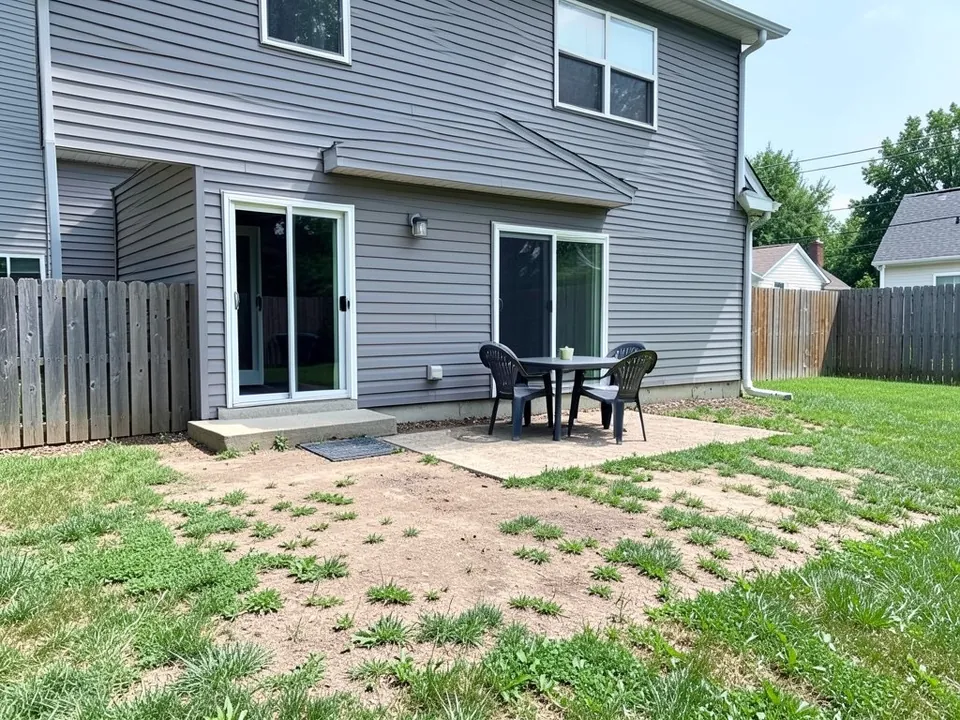
Before
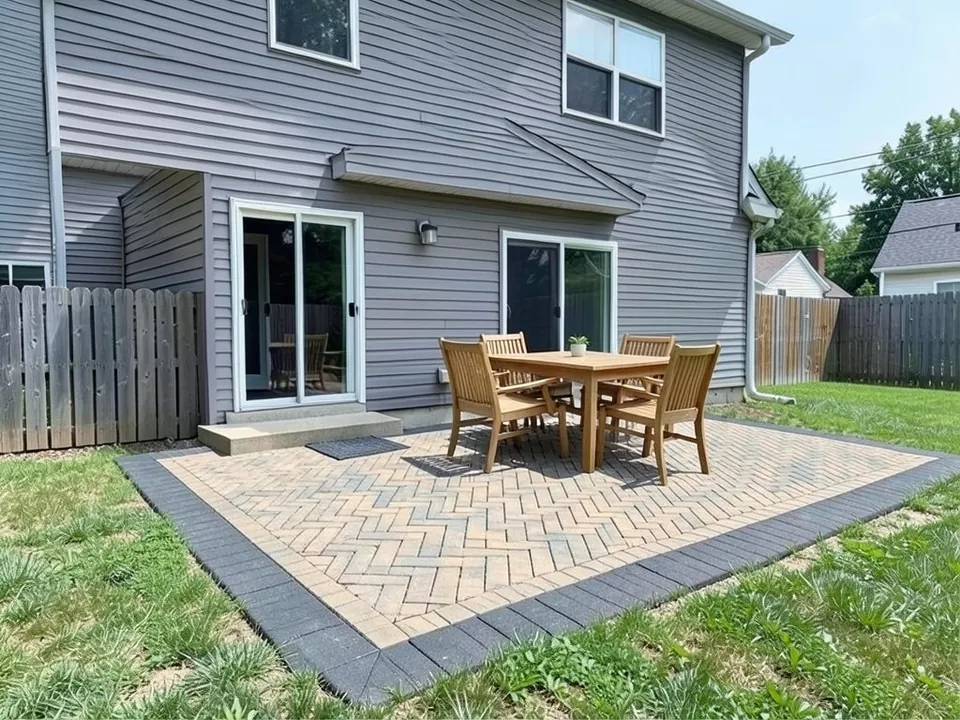
After
2. Round fire pit patio, 14 ft across: 493 pavers
A circle 14 ft across is 153.9 sq ft. A circular pattern means many cut pavers, so allow 20%: 184.7 sq ft, or 493 pavers of 6 × 9 in. A 4 in base is 2.28 yd³ (3.0–3.4 tons), the sand bed 0.48 yd³, and the edge 44 ft around. A steel fire ring sits on top of the pavers, so we did not take its area off; for a built-in pit, work out the pit as a second circle and subtract it. Metric: a 4.27 m circle is 14.3 m²; with 20% extra, 430 pavers of 20 × 20 cm.
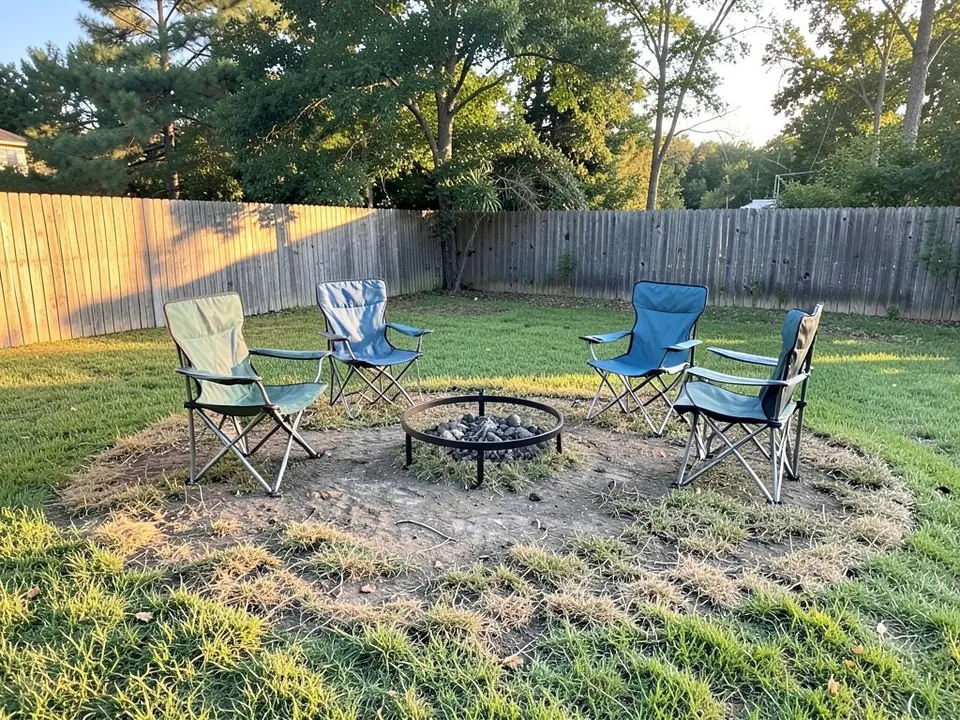
Before
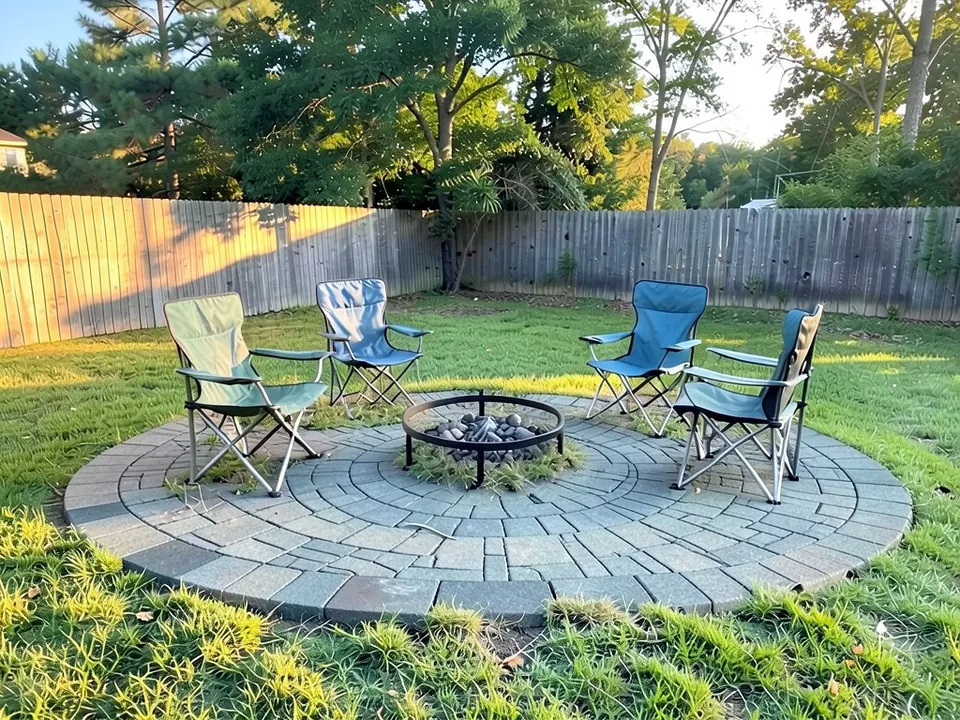
After
3. Curved brick walk, 3 × 30 ft: 486 pavers
A walk 3 ft wide and 30 ft long is 90 sq ft. It curves and it is laid in herringbone, so allow 20%: 108 sq ft, or 486 pavers of 4 × 8 in. A 4 in base is 1.33 yd³ (1.7–2.0 tons), the sand 0.28 yd³ and the joints 2 bags of polymeric sand. Edging runs along both sides, 60 ft; the calculator shows 66 ft because it also counts the two ends, which here meet the gate and the house. Metric: 0.91 × 9.14 m is 8.4 m²; with 20% extra, 502 pavers of 10 × 20 cm.
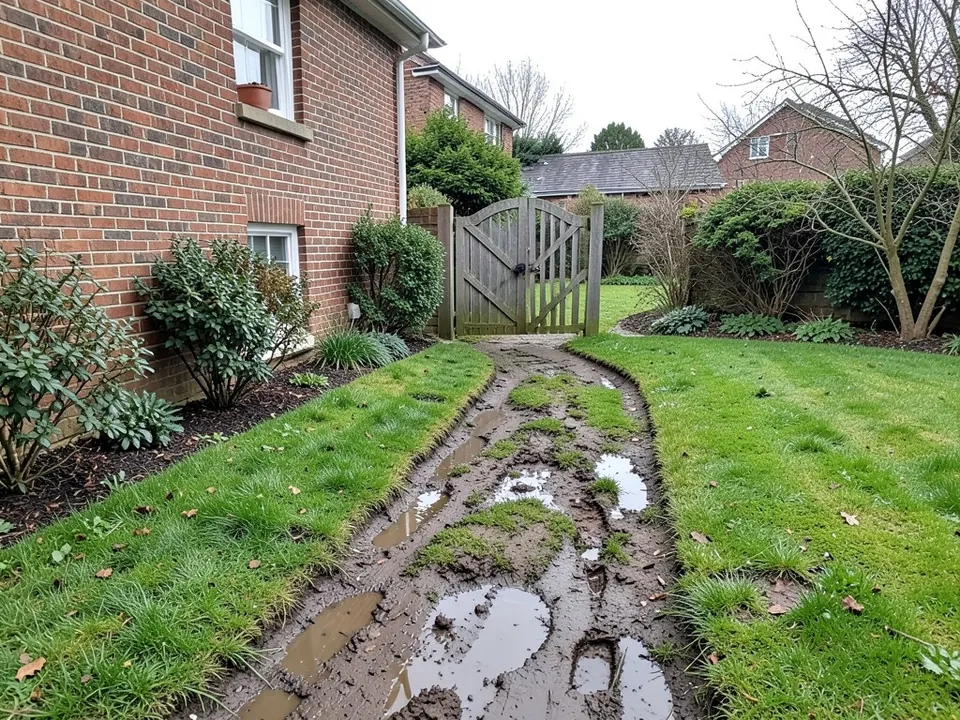
Before
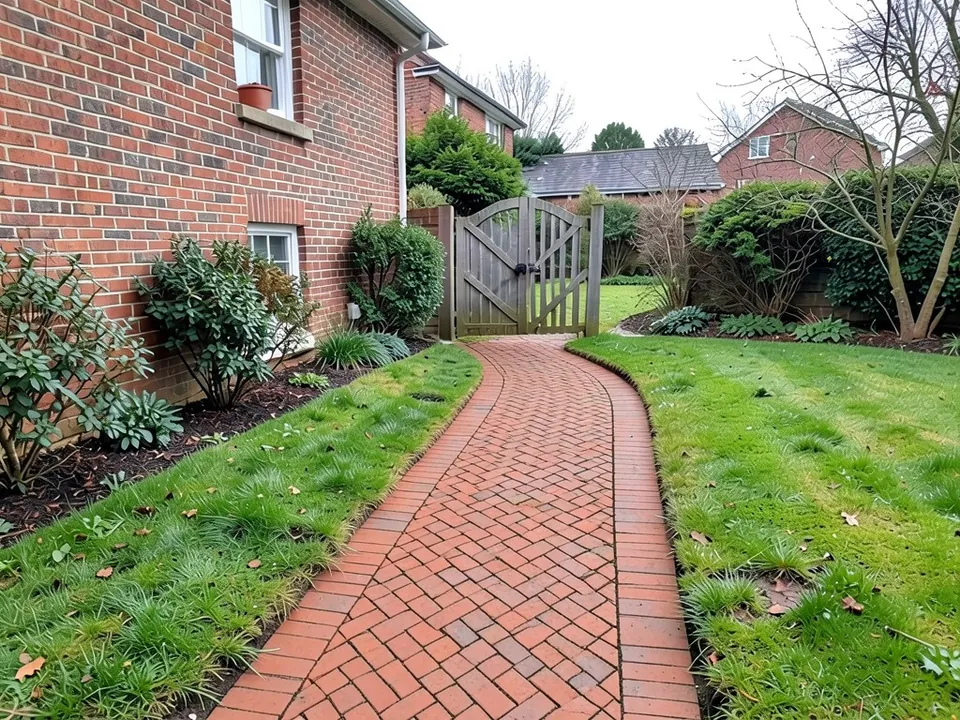
After
4. Modern patio in 24 × 24 in slabs: 47 pavers
14 × 12 ft is 168 sq ft. Large square slabs in a straight grid need 10% extra: 184.8 sq ft. Each 24 × 24 in slab covers 4 sq ft, so 47 slabs. A 4 in base is 2.49 yd³ (3.2–3.7 tons) and the sand bed 0.52 yd³. Metric: 4.27 × 3.66 m is 15.6 m²; with 10% extra, 48 slabs of 60 × 60 cm. Installed by a pro: about $1,344–$4,032.
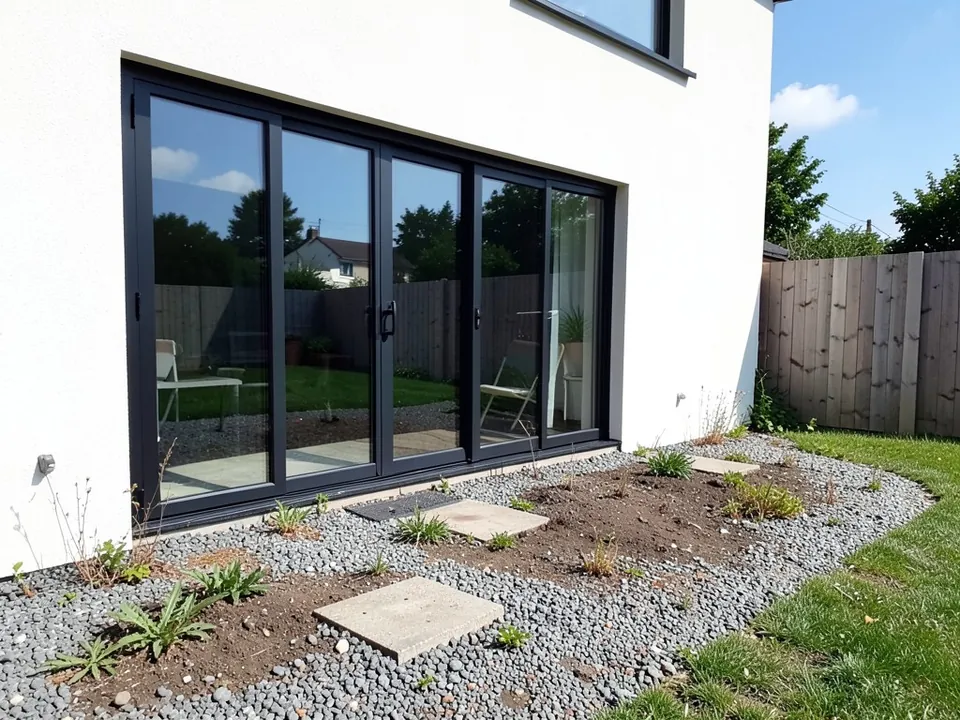
Before
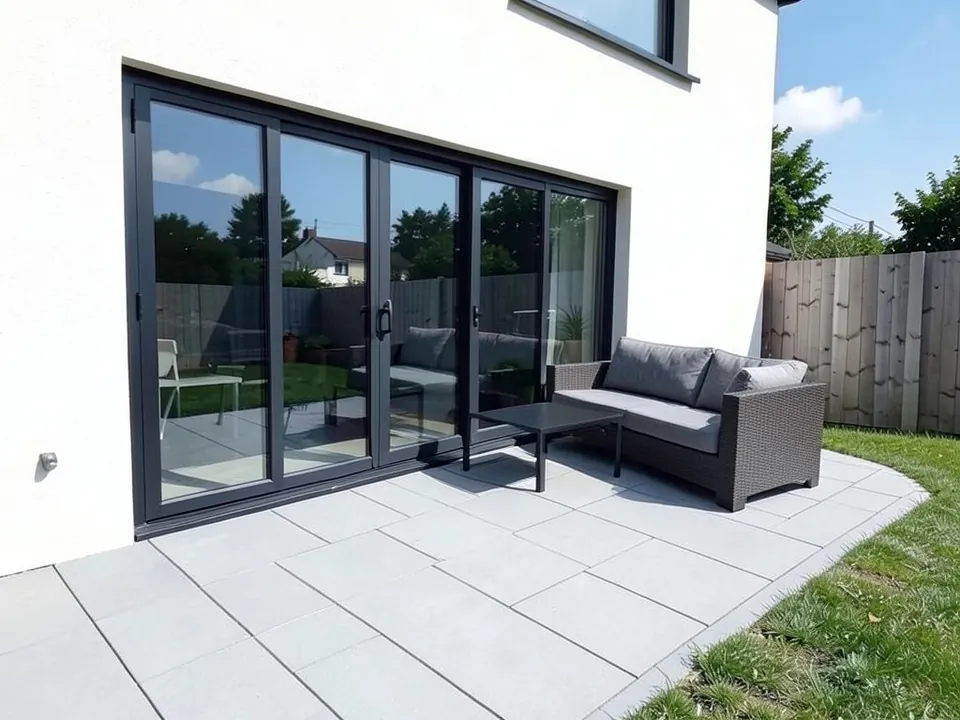
After
Planning a patio? Upload a photo of your yard and try the shape, the pattern and the paver color before you order.
Design my patio from a photoHow much does a paver patio cost?
LawnLove's prices for the US:
- Installed: $8–$24 per sq ft, with an average of $3,350 for a 280 sq ft patio.
- Pavers only, per sq ft: concrete $4–$6, brick $4–$8, natural stone $7–$16.
Inch Calculator gives $8–$20 per sq ft installed. Prices vary a lot by region and paver, so type your supplier's price per paver into the calculator.
How to lay a paver patio
- Mark and dig. Dig to the base depth plus 1 in of sand plus the paver. Belgard says to dig at least 12 in wider than the pavers; Unilock says the base should reach past the edge by as much as it is deep.
- Slope it. Unilock gives a slope of 1–2% so water drains off the patio.
- Lay and compact the base. Spread the gravel in layers of 3–4 in (Unilock) and compact each one; Belgard uses a plate compactor of at least 7,000 lbf.
- Screed the sand. Spread a 1 in bed of sand and level it. Do not compact it before the pavers go down (Unilock).
- Lay the pavers. Start at a straight edge, keep the pattern square, and cut the edge pieces last.
- Edge and fill the joints. Fix an edge restraint around the outside, then sweep polymeric sand into the joints and wet it as the bag says.
See the paver patio on a photo of your own yard
Before you order pallets, try it: upload a photo of your yard to our AI landscape tool and see where a patio, a path or a fire pit area could go. For ideas, see our patio design ideas, paver driveway ideas and flagstone patio ideas.
Design my patio from a photo1 free render with a free account (sign in with Google or an email code). More renders come with a paid plan (see pricing).
Paver calculator questions
How do I calculate how many pavers I need?
Multiply length by width to get the area in square feet (for a circle, 3.14 × radius²). Add 10% for a straight pattern or 20% for herringbone or diagonal. Work out the area of one paver: width × length in inches ÷ 144 (a 4 × 8 in paver is 0.22 sq ft). Divide the area by the paver area and round up. A 12 × 12 ft patio of 4 × 8 in pavers with 10% extra needs 713 pavers.
How many pavers are in a square foot?
Inch Calculator gives, per 100 sq ft: 450 pavers of 4 × 8 in, 400 of 6 × 6 in, 267 of 6 × 9 in, 225 of 8 × 8 in and 100 of 12 × 12 in. So a square foot takes 4.5 of 4 × 8 in, 4 of 6 × 6 in or 1 of 12 × 12 in. For any other size, divide 144 by width × length in inches.
How much extra pavers should I buy?
Inch Calculator says at least 10% for a straight pattern and at least 20% for a diagonal or herringbone pattern, to cover cuts and breakage. We use 20% for curves and circles too, because the edges are all cut pieces.
How much base do I need for pavers?
Unilock gives 4 to 6 inches of compacted base for walkways and patios and 8 to 12 inches for driveways, compacted in layers of 3 to 4 inches. Inch Calculator adds 20% gravel because it compacts. For a 12 × 16 ft patio with a 4 in base, that is 2.84 yd³, and at 1.3–1.5 tons per yd³ for 3/4 in minus (GravelShop), 3.7–4.3 tons.
How much sand do I need for pavers?
Belgard uses a 1 in bed of sand under the pavers. One inch over 100 sq ft is 0.31 yd³ (square feet ÷ 324). For the joints, a 50 lb bag of Alliance Gator G2 polymeric sand covers 65–85 sq ft with narrow joints of 1/8–3/8 in and 22–42 sq ft with wide joints of 3/4–1 1/4 in, for 2 3/8 in pavers.
How deep do I dig for a paver patio?
Add the base, the 1 in sand bed and the paver itself. With a 4 in base and 2 3/8 in pavers, that is about 7.4 in; with an 8 in driveway base, about 11.4 in. Belgard says to dig at least 12 in wider than the pavers, and Unilock says the base should extend past the edge by as much as it is deep.
How much does a paver patio cost?
LawnLove puts a paver patio at $8–$24 per sq ft installed, with an average of $3,350 for 280 sq ft. Materials alone run $4–$6 per sq ft for concrete pavers, $4–$8 for brick and $7–$16 for natural stone. Inch Calculator gives $8–$20 per sq ft installed.
How many pavers are on a pallet?
Inch Calculator says a pallet holds 78–160 sq ft of pavers, depending on the size and thickness. The square feet are on the pallet label or the maker's spec sheet; type them into the calculator to get pallets. For example, a pallet of 120 sq ft of 4 × 8 in pavers holds 540 pavers.
Sources for the sizes, depths and prices
Read on 11 November 2026.
- Inch Calculator, Paver calculator: pavers per 100 sq ft, extra by pattern, polymeric sand, pallets and installed cost
- Inch Calculator, Paver base calculator: base depth for patios and driveways, 1 in sand, 20% extra gravel for compaction
- Omni Calculator, Paver calculator: 4 × 8 in as the most common size
- Unilock, Dos and don'ts of paver installation, base preparation: base depth, layers, slope and edges
- Belgard, Technical Resource Guide, page 13: sand bed, base lifts, plate compactor and excavation width
- GravelShop, 3/4 in minus crushed limestone: weight per cubic yard
- Alliance Gator G2 polymeric sand, 50 lb bag: coverage by joint width
- LawnLove, Paver patio cost: installed and material prices per square foot