
How to use the sod calculator
- Pick Feet or Metres. Switching converts the sizes you already typed.
- Pick the shape: Rectangle (length and width), Circle (diameter), Triangle (base and height) or Area if you already know the square feet or square metres. For an odd-shaped lawn, split it into rectangles, circles and triangles, work out each one and add them up.
- Choose the extra for cutting and waste: +5% for a plain rectangle, +10% for most lawns, +15–20% for curves, beds, trees and patching (see how much extra, below).
- Pick the size of piece your supplier sells: a 2 × 5 ft roll (10 sq ft) is the most common in the US, slabs of 16 × 24 in are sold at garden centres, and UK turf comes in rolls of about 1 m². In US units, also pick what a pallet covers: 450 or 500 sq ft.
- Add a price per square foot (or per m² or roll) and a price per pallet if you have them, to see the cost before delivery and labor.
- Read the answer: square feet and square yards (or m²), the number of rolls or slabs, and the pallets as full pallets plus loose rolls. The small line underneath gives the topsoil for a 4 in (10 cm) bed under the sod.
The results are estimates. Measure the lawn itself, not the whole yard: leave out the beds, paths, patio and the mulch rings around trees, and round each measurement up to the next foot.
Sod formula: square feet, rolls and pallets
- Square feet = length (ft) × width (ft), plus 5–20% extra
- Square yards = square feet ÷ 9
- Rolls = square feet ÷ 10 for a 2 × 5 ft roll (÷ 2.67 for a 16 × 24 in slab), rounded up
- Pallets = square feet ÷ 450 (or ÷ 500, if that is what your supplier's pallet covers)
Example: a 50 × 30 ft back yard is 1,500 sq ft. With 10% extra: 1,650 sq ft = 183 sq yd, 165 rolls of 10 sq ft, or 3.7 pallets of 450 sq ft. Order 4 pallets, or 3 pallets and 30 rolls.
In metric: area (m²) = length × width, plus the extra; UK turf rolls are about 1 m², so the rolls equal the square metres, rounded up. A 10 × 8 m lawn is 80 m²; with 10% extra, 88 rolls.
Sod roll, slab and pallet sizes
Sod is cut in different sizes by different farms, so check before you order. These are the common ones, with how many fit on a 450 sq ft pallet.
| Piece | Covers | Per 450 sq ft pallet | Source |
|---|---|---|---|
| Roll, 2 × 5 ft | 10 sq ft | 45 | LawnStarter and Inch Calculator: about 10 sq ft |
| Slab, 16 × 24 in | 2.67 sq ft | 169 | Inch Calculator: slabs of 2.67 sq ft |
| Long roll, 2 × 10 ft | 20 sq ft | 22–23 | Ask your supplier; sizes vary |
| UK roll, 61 × 164 cm | about 1 m² (10.8 sq ft) | sold by the roll | Rolawn: 15–20 kg per roll |
A pallet of sod covers 450–500 sq ft and weighs 1,500–3,000 lb (Inch Calculator), so plan for delivery. Inch Calculator suggests buying by the pallet once you need more than about 400 sq ft; below that, loose rolls or slabs are simpler.
How much extra sod to order
Every lawn needs some sod cut to fit at the edges, around trees and along curves. Omni adds 10% by default and up to 20% for lawns with many trees or rocks; Rolawn's calculator adds 5% for cutting and shaping.
- +5%: a plain rectangle with straight edges.
- +10%: most lawns, with a tree or two and a bed edge.
- +15–20%: curved beds, many trees, or patching an old lawn, where each patch is cut back to a square edge.
How much does sod cost?
LawnStarter's averages for the US:
- Sod only: about $0.60 per sq ft; a pallet of 450–500 sq ft for $150–$450; a 2 × 5 ft roll for $4–$7.50.
- Installed: about $1.65 per sq ft, with labor at $0.55–$1 per sq ft.
- Delivery: $65–$230.
- 1,000 sq ft: $732–$1,354 doing it yourself, $1,000–$2,200 with a pro.
- By grass: Bahia from about $0.20 per sq ft, Kentucky bluegrass $0.29–$0.43, St. Augustine $0.41–$0.86, Zoysia $0.47–$0.72.
In the UK, Rolawn lists its Medallion turf at £6.25–£12.65 per 1 m² roll, cheaper the more you buy. Prices vary a lot by region, grass and season, so enter your own supplier's prices in the calculator.
Sod before and after: 4 lawns, with the sums
The left image of each pair was generated by AI as a stand-in for an ordinary yard, and the right image is that same picture edited by AI from a written instruction. They are not photos of real homes; we made them with our own AI model, which is not one of the models you can pick in the landscape tool. Two of the four were run three times, as their captions say.
1. New-build front yard: 3 pallets
A 40 × 30 ft front yard is 1,200 sq ft (133 sq yd). With 10% extra, 1,320 sq ft: 132 rolls of 10 sq ft, or 2.9 pallets of 450 sq ft, so order 3 pallets (or 2 pallets and 42 rolls). At LawnStarter's average of $0.60 per sq ft that is about $790 of sod; installed, at $1.65 per sq ft, about $1,980. The 4 in topsoil bed under it is 14.8 yd³. Metric: 110 m² with 10% extra is 121 rolls of 1 m², about 1.8–2.4 tonnes.
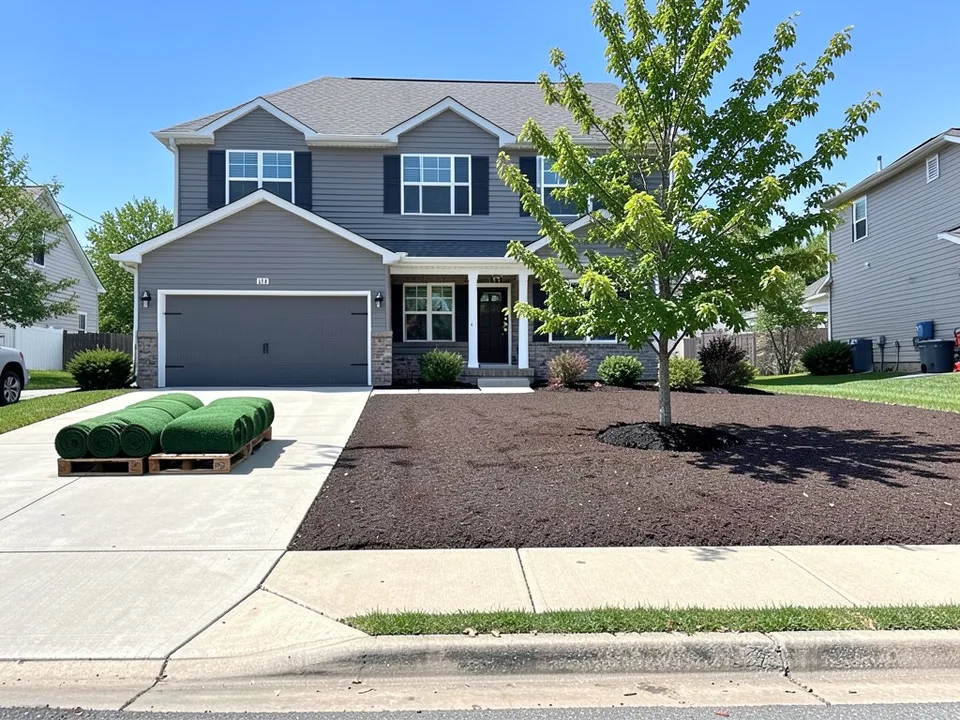
Before
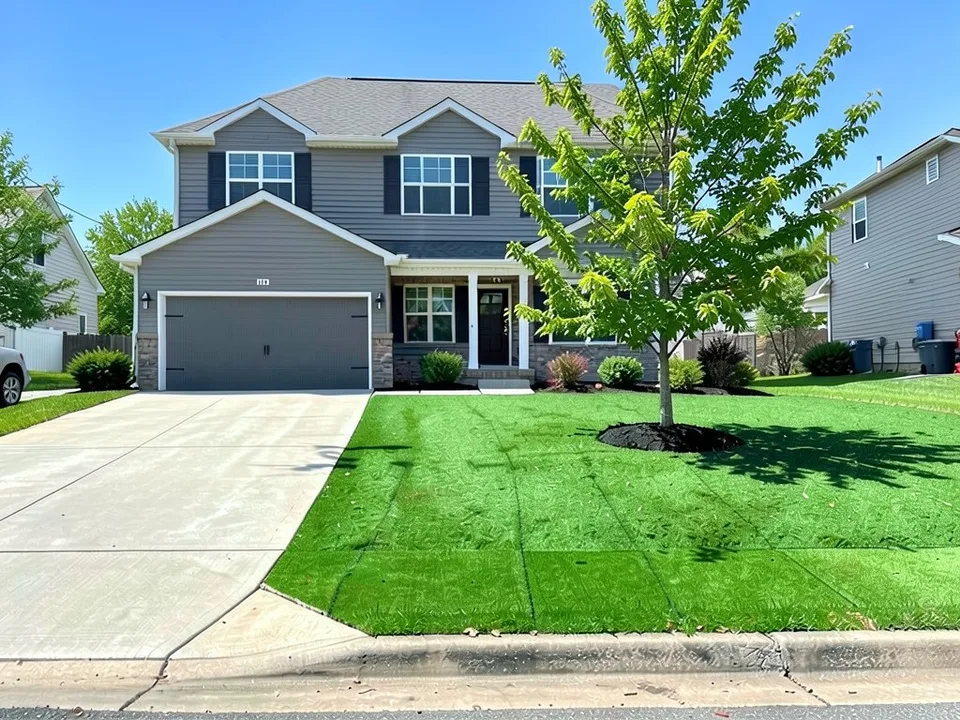
After
2. Patching dead spots in a lawn: rolls, not pallets
Three dead patches of about 8 × 10, 4 × 5 and 4 × 6 ft add up to 124 sq ft. Cut each one back to a square edge in healthy grass and allow 15% for that: 143 sq ft, or 15 rolls of 10 sq ft (54 slabs). That is a third of a pallet, so buy loose rolls or slabs. Metric: 11.5 m² with 15% extra is 14 rolls.
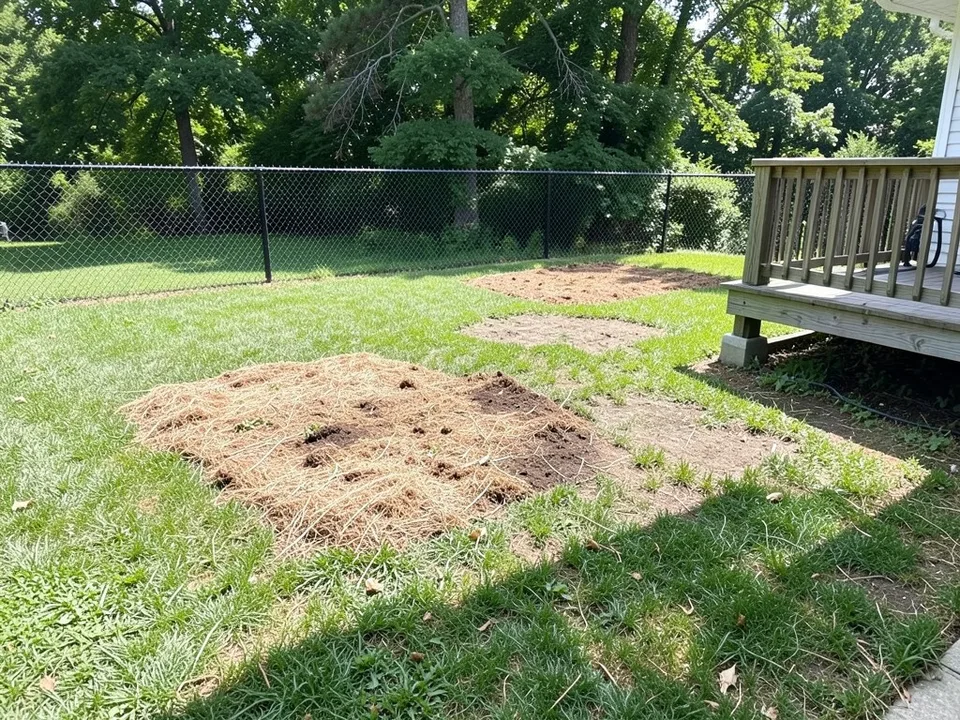
Before
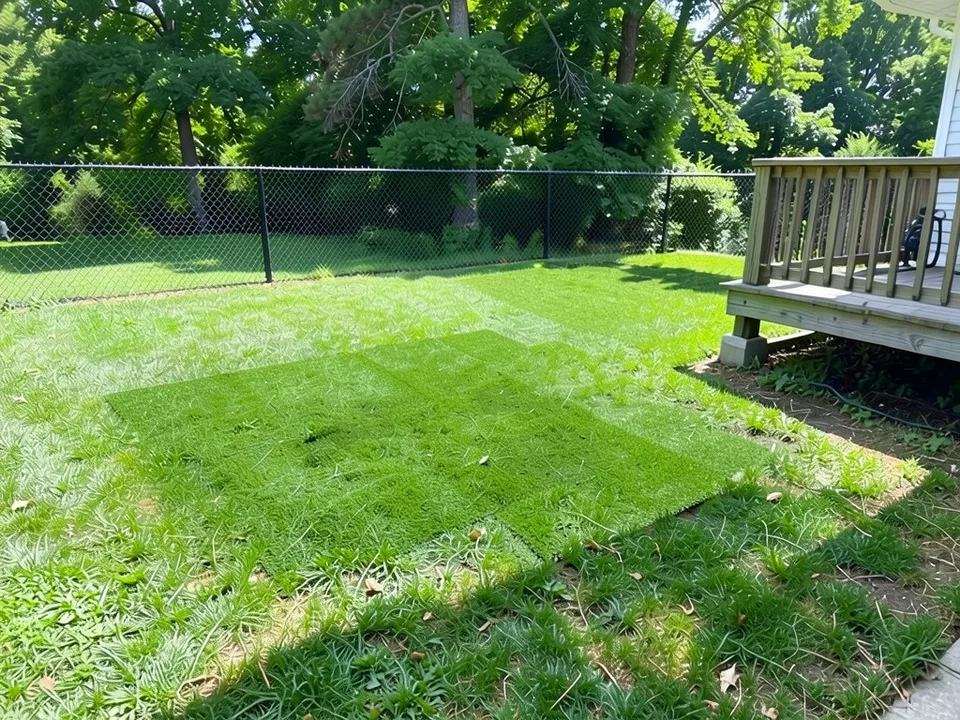
After
3. Curved lawn between edged beds: allow 15%
The open lawn between the beds is about 450 sq ft. Every edge is a curve, so allow 15%: 518 sq ft, which is 52 rolls of 10 sq ft, or 1 pallet of 450 sq ft and 7 rolls. Metric: 42 m² with 15% extra is 49 rolls.
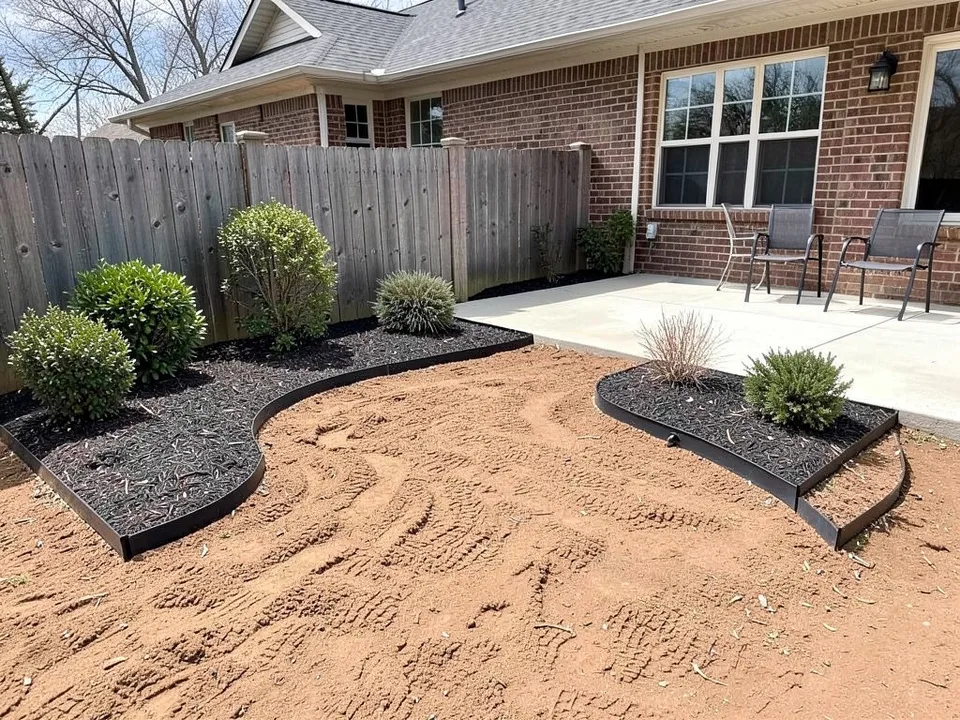
Before
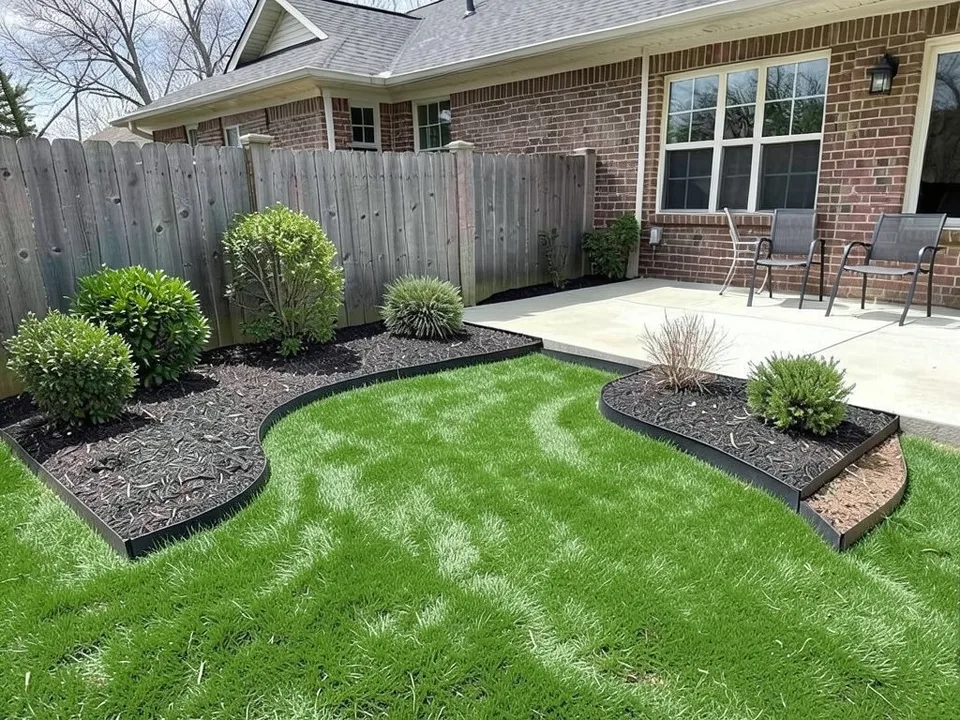
After
4. Narrow side yard: a strip of sod
A side yard 6 ft wide and 40 ft long is 240 sq ft. It is a plain rectangle, so +5% is enough: 252 sq ft, or 26 rolls of 10 sq ft, just over half a pallet. Metric: 1.8 × 12 m is 21.6 m², 23 rolls with 5% extra. A strip between a house and a tall fence can be shady; ask your supplier for a grass that suits the light it gets.
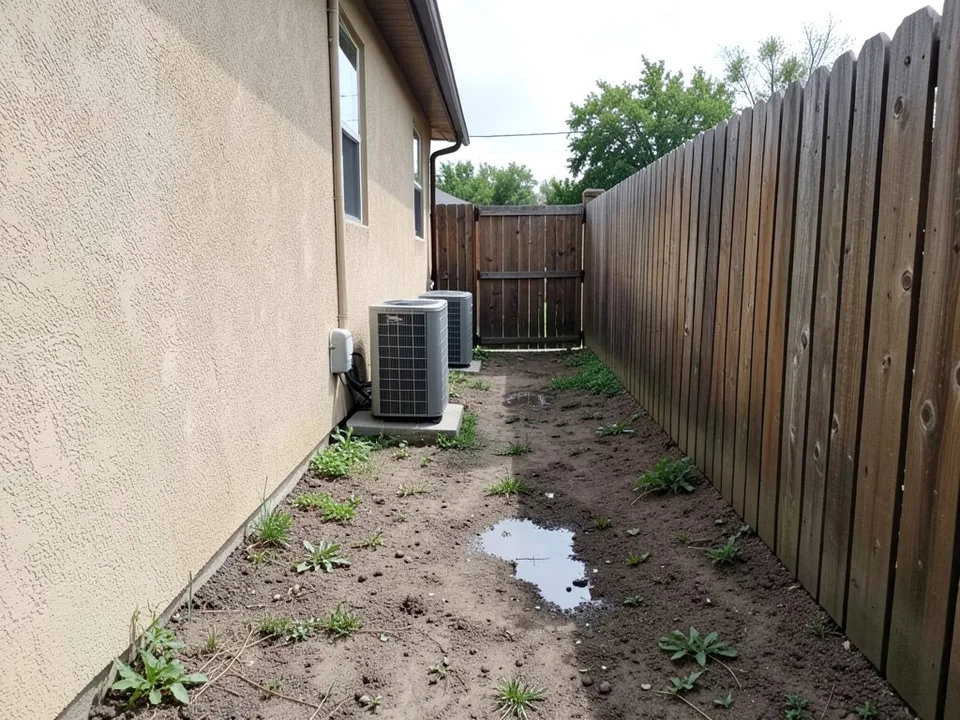
Before
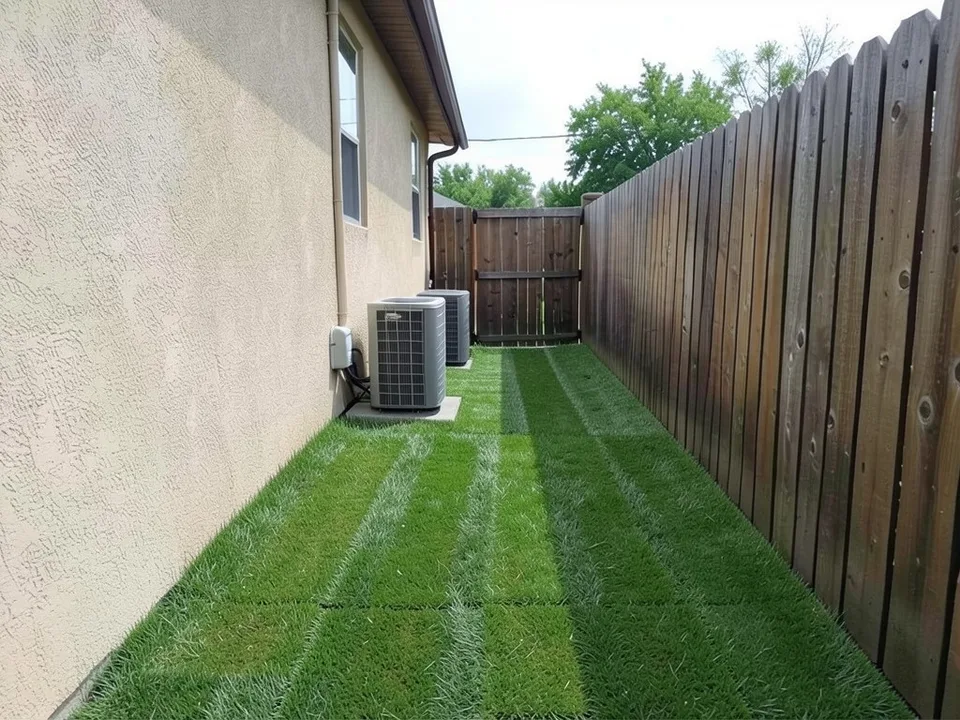
After
Planning a new lawn? Upload a photo of your yard and see where the lawn and the beds could go before you order the sod.
Design my yard from a photoHow to prepare the ground and lay sod
- Clear the weeds. Sod Solutions advises spraying existing weeds 10–14 days before you lay.
- Loosen and add topsoil. Penn State Extension says to till at least 4 inches deep and that a minimum of 4–6 inches of good topsoil is typically needed. Use the topsoil calculator for the amount.
- Level and firm it. Rake out stones and let rain or a sprinkler settle the soil, so the new lawn does not sink in patches.
- Order for the day you lay. Penn State: sod deteriorates within 24 to 48 hours in warm weather, so lay it as soon as it arrives. Never lay it on wet soil.
- Lay it like bricks. Stagger the joints, butt the edges tight, and cut pieces with a sharp knife at curves and beds. Penn State advises smoothing it with a light roller before watering.
- Water deeply, then daily. Make sure the water goes through the sod and wets the soil underneath (Sod Solutions: until the soil is moist 3–4 inches down), then water daily if needed until it roots, which Penn State says may take up to 4 weeks. Keep off it until it is well rooted.
Timing: Penn State says sod can go down almost any time the soil is not frozen, with spring, late summer and fall the best times for cool-season grasses.
See the new lawn on a photo of your own yard
Before you buy pallets, try the layout: upload a photo of your yard to our AI landscape tool and see where the lawn ends and where beds, paths or a patio could go. For ideas, see our front yard landscaping ideas and backyard landscaping ideas; for a lawn that needs less mowing, see clover lawn ideas.
Design my yard from a photo1 free render with a free account (sign in with Google or an email code). More renders come with a paid plan (see pricing).
Sod calculator questions
How do I calculate how much sod I need?
Measure the lawn and multiply length by width to get square feet (for a circle, 3.14 × radius²; for a triangle, base × height ÷ 2). Add 5–10% for cutting, or 15–20% for curves and patching. Divide by the size of one piece (10 sq ft for a 2 × 5 ft roll) to get rolls, and by 450 or 500 to get pallets. Divide square feet by 9 for square yards.
How much sod is on a pallet?
Usually 450–500 sq ft (LawnStarter and Inch Calculator). With 2 × 5 ft rolls of 10 sq ft, a 450 sq ft pallet holds 45 rolls. Inch Calculator gives a pallet weight of 1,500–3,000 lb, so it comes by truck and should be laid the day it arrives. Ask your supplier what their pallet covers, because it varies by farm and grass.
How many square feet is a roll of sod?
A standard US roll is 2 × 5 ft, about 10 sq ft. Slabs sold at garden centres are often 16 × 24 in, 2.67 sq ft. UK turf rolls are about 1 m² (61 × 164 cm), or 10.8 sq ft, and weigh 15–20 kg (Rolawn).
How much sod do I need for 1,000 square feet?
With 10% extra, 1,100 sq ft: 110 rolls of 10 sq ft, or 2.4 pallets of 450 sq ft. Order 3 pallets, or 2 pallets and 20 loose rolls if your supplier sells both.
How much does sod cost?
LawnStarter puts sod at about $0.60 per sq ft, or $1.65 per sq ft installed, and a pallet at $150–$450. For 1,000 sq ft it gives $732–$1,354 to do it yourself and $1,000–$2,200 with a pro. Delivery adds $65–$230. In the UK, Rolawn lists its Medallion turf at £6.25–£12.65 per 1 m² roll, depending on how many you buy.
How much extra sod should I order?
Omni uses 10% by default and up to 20% for a lawn with many trees or rocks; Rolawn's calculator adds 5% for cutting and shaping. Use 5% for a plain rectangle, 10% for most lawns and 15–20% for curves, beds and patching.
How much topsoil do I need under sod?
Penn State Extension says a minimum of 4 to 6 inches of good topsoil (firmed or settled depth) is typically needed to establish a lawn, tilled at least 4 inches deep. Over a lawn of 1,000 sq ft, 4 inches is 12.3 cubic yards. Our topsoil calculator works it out for any size.
When is the best time to lay sod?
Penn State says sod can be laid almost any time of year except when the soil is frozen, and that spring, late summer and fall are best for cool-season grasses. Lay it the day it arrives: it deteriorates within 24 to 48 hours in warm weather. Never lay it on wet soil.
Sources for the sizes, prices and steps
Read on 11 November 2026.
- Inch Calculator, Sod calculator: roll, slab and pallet sizes and pallet weight
- Omni Calculator, Sod calculator: waste of 10% by default, up to 20% with many trees or rocks
- LawnStarter, Sod prices: cost per square foot, per pallet and installed, roll size
- Penn State Extension, Lawn Establishment: topsoil depth, tilling, timing, laying and watering sod
- Sod Solutions, Sod installation guide: weed control before laying, brick pattern and first watering
- Rolawn, Medallion turf: UK roll size, weight and price per roll