
Zones to plan for a dog
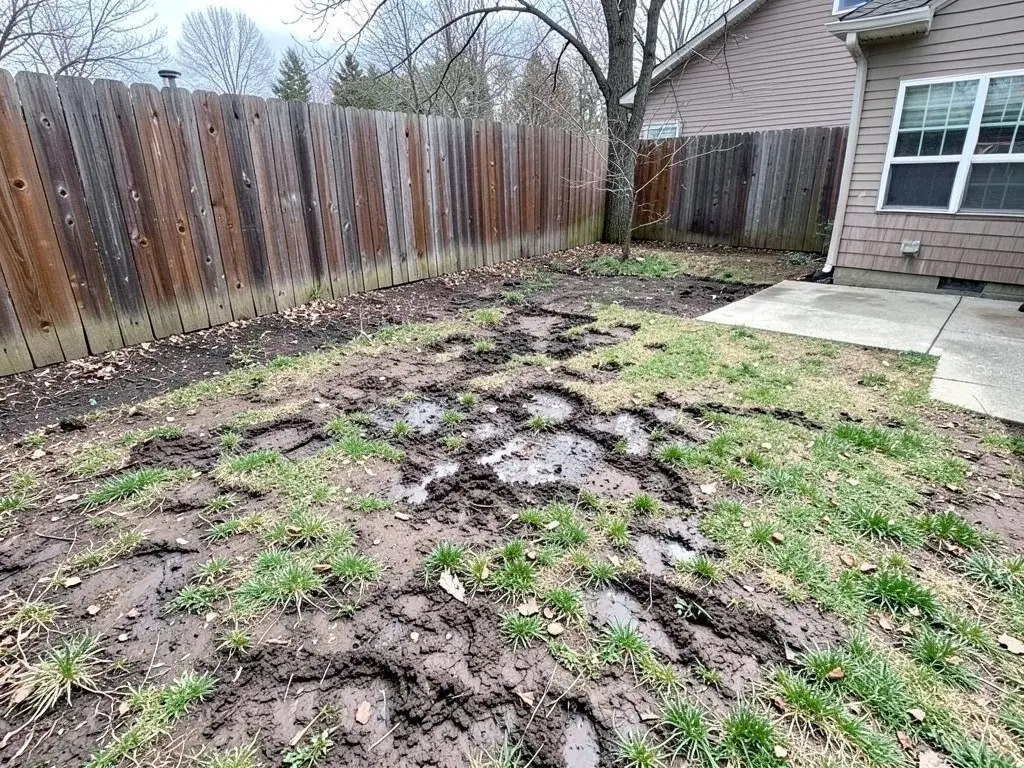
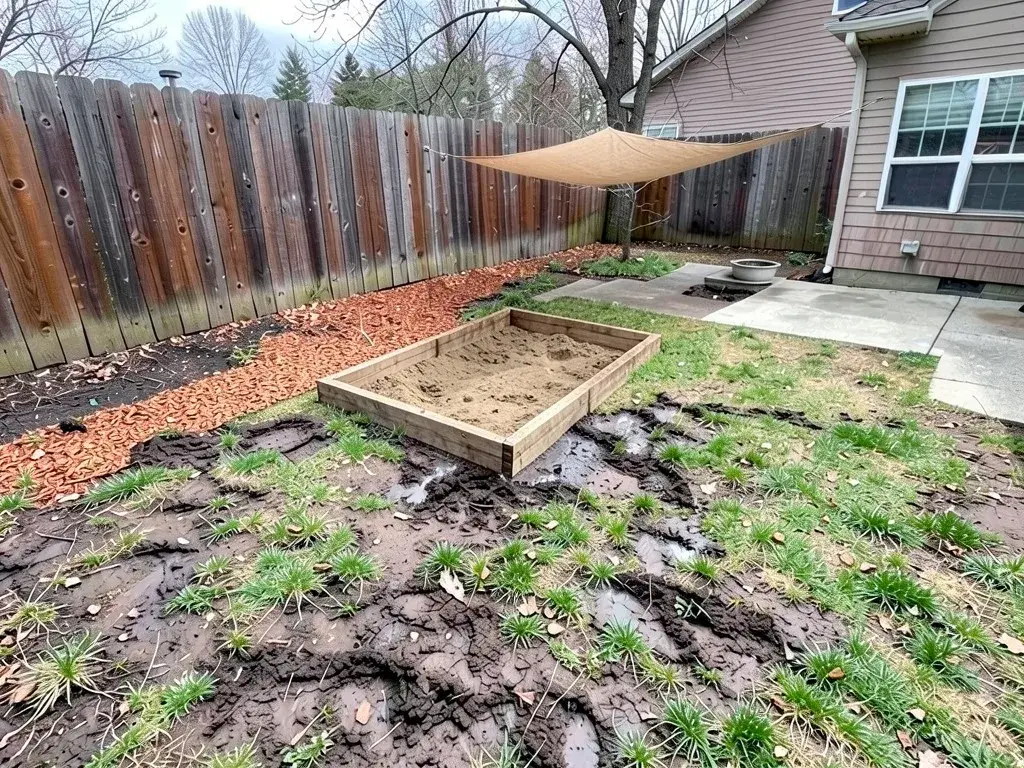
Most dogs run the fence line, so instead of fighting worn grass there, give them a path about 2 to 3 ft wide of wood chips or gravel along the fence. Add a dig pit of loose sand or soil framed with boards, where digging is allowed. Plan shade and fresh water near where they rest, a potty area away from the patio, and tough cover such as clover or creeping thyme where paws wear the lawn.
Check the fence: dogs that dig may need wire buried along the base, and some need a taller fence than a person would.
Plants and mulch to keep out
The ASPCA lists sago palm, oleander, azalea, yew, foxglove and lily of the valley as toxic to dogs; sago palm is among the most dangerous. Avoid cocoa bean mulch: it contains theobromine, the same compound that makes chocolate toxic to dogs.
Flowers such as snapdragons, zinnias and sunflowers are on the ASPCA's non-toxic list. Look up every plant on that list before you plant it, and ask your vet if your dog chews plants.
Dog-safe plants for a backyard
The section above lists what to keep out. This table lists common garden plants that the ASPCA's toxic and non-toxic plant list for dogs marks as non-toxic. We checked each one on that list on 10 November 2026, by its scientific name. The last column is where the plant suits a yard with a dog, from the pages named under it.
| Plant (scientific name on the ASPCA list) | Kind | Where it fits in a dog yard |
|---|---|---|
| Camellia (Camellia japonica) | Evergreen shrub | Back of a border. Lawn Love suggests it in place of azalea or rhododendron, which are toxic, for the same part-shade look. |
| Star magnolia (Magnolia stellata) | Small tree or large shrub | A single feature plant. WSU Extension names magnolias as a good choice for a yard with a dog. |
| Crape myrtle (Lagerstroemia indica) | Small flowering tree | A flowering tree for the back of the yard. |
| Coral bells (Heuchera sanguinea) | Perennial | The front of a border. |
| Coreopsis, tickseed (Coreopsis) | Perennial | A sunny border. WSU Extension lists it among dog-friendly plants. |
| Lilyturf (Liriope muscari) | Grass-like perennial | Edging along a path or a bed. |
| Pot marigold (Calendula officinalis) | Annual | A sunny bed. The ASPCA's non-toxic marigold is this one, calendula. |
| Zinnia (Zinnia) | Annual | A sunny bed or a raised bed. |
| Snapdragon (Antirrhinum majus) | Annual | Beds and raised beds. |
| Petunia (Petunia) | Annual | Pots and bed edges. WSU Extension lists it as safe for dogs. |
| Common thyme (Thymus vulgaris) and rosemary (Rosmarinus officinalis) | Herbs | A raised herb bed. Lawn Love suggests creeping thyme between stepping stones; the ASPCA entry is common thyme, so check the exact thyme you buy. |
| Rose (Rosa) | Shrub | Not toxic, but Penn State Extension and Sunset warn that thorns can hurt a dog's eyes and paws, so keep roses away from paths. |
Three plants many people expect to be safe are on the ASPCA's toxic list for dogs: English lavender (Lavendula angustifolia), hosta and hydrangea. Common names are shared between plants, so look each one up by its scientific name.
How to plant so the plants survive the dog: Sunset's readers say densely planted areas keep dogs out, and suggest raised beds or mounds and plants bought in 1-gallon pots or larger. Put tough shrubs and ornamental grasses at the edge of a bed and brittle plants such as salvias in the middle. Penn State Extension says that if your dog patrols the fence, leave 2 to 3 ft between the fence and the planting beds.
Fences and borders for a dog-friendly yard
A fence does two jobs in a dog yard: the outer fence keeps the dog in, and low borders inside the yard show the dog where it may not go. None of the pages we read gives one fence height for every dog. These are the fence and border ideas they do give.
- Check the rules first: Milorganite's guide says to check with your homeowners association and town for fence rules before you build, so the fence does not have to be moved back from the lot line or taken down.
- Stop digging under the fence: For a dog that tunnels, Sunset suggests an underground barrier of rebar, chicken wire or poured concrete along the fence. One garden it shows uses boards along the bottom of the fence.
- Leave a strip along the fence: Dogs run the fence line. WSU Extension and Penn State Extension both say to leave a few feet between the fence and your plants; Penn State gives 2 to 3 ft.
- Low borders inside the yard: Penn State Extension says short fences or borders show a dog which areas are off-limits, and using the same material for every barrier helps the dog recognize them. Lawn Love suggests low wood, stone or wire edging around trees, shrubs and beds against digging, trampling and urine.
- Fence new plantings for a while: Sunset suggests temporary fencing around newly planted areas, then a rock border or a low fence as a reminder once it comes down.
- A fenced dog zone: Lawn Love suggests fencing off one part of the yard for the dog, with fresh water, shade, a comfortable ground cover and toys. If you want turf in that zone, our artificial grass for dogs page covers dog runs on turf.
- A window in a solid fence: Lawn Love describes a small clear, shatter-resistant panel in a wood or vinyl fence so a dog can look out, but warns against it for a dog that is reactive or anxious about people, cars or other dogs going by.
Dog paths: surfaces that are easy on paws
Dogs wear the same routes into a lawn. Penn State Extension, Sunset, Milorganite and Lawn Love all say the same thing: notice the route your dog already takes and turn it into a path, instead of trying to grow grass on it. Milorganite says grass usually does not survive the constant traffic, and Sunset says a clearance about 3 ft wide is enough for most dogs.
| Surface | What the pages say | Watch for |
|---|---|---|
| Cedar chips | Sunset: small cedar chips are easy on paws, yet large enough not to cling to silky coats. Lawn Love lists cedar mulch for a perimeter loop. | WSU Extension: some dogs eat wood chips. Lawn Love suggests undyed chips. |
| Flagstone and pavers | Penn State Extension lists flagstones as paw-friendly. Sunset shows smooth flagstones set in pebbles. Lawn Love lists pavers for a loop. | Lawn Love: light-colored stone stays cooler underfoot than dark stone on a hot afternoon. |
| Smooth gravel and pea gravel | Penn State Extension: smooth gravel, nothing sharp. Lawn Love lists pea gravel for a loop, and Sunset lists it for a potty area. | Sharp or crushed stone: Penn State says to use nothing sharp. |
| Creeping thyme between stones | Lawn Love: low-growing and suited to planting between stepping stones or pavers. | The ASPCA lists common thyme as non-toxic; check the thyme you buy. |
| White clover | Lawn Love: soft underfoot, drought-tolerant, self-repairing, and less likely than turfgrass to show urine spots. | Clover is not on the ASPCA list either way. |
Mulches to skip on a dog path: cocoa mulch (see above), pine needle mulch, which WSU Extension says can damage a dog's stomach lining, and rubber mulch, which Lawn Love says may be a hazard if chewed or swallowed.
Milorganite suggests planting next to the running path, not in it, with tough ornamental grasses or shrubs to screen it. Lawn Love suggests making it a deliberate loop around the yard, so the dog's runs stay on the path and off your beds.
How to try dog-friendly ideas on your own photo
The tool above is in Custom mode, which has a Custom Design Requirements box. Describe the path, the dig pit, shade, water and play area, and where each one goes.
- Take the photo in daylight from the back door, with the fence and the worn areas in frame.
- Describe the change in the Custom Design Requirements box: what to add, where it goes, and what must stay, such as the house, fence or patio.
- Upload your photo under Upload Your Garden Image and click Generate Custom Design. You sign in with an email code or Google when you generate.
- Compare the result with your photo. If something is in the wrong place or too big, name the spot and the size, and try again.
What the AI can and cannot do
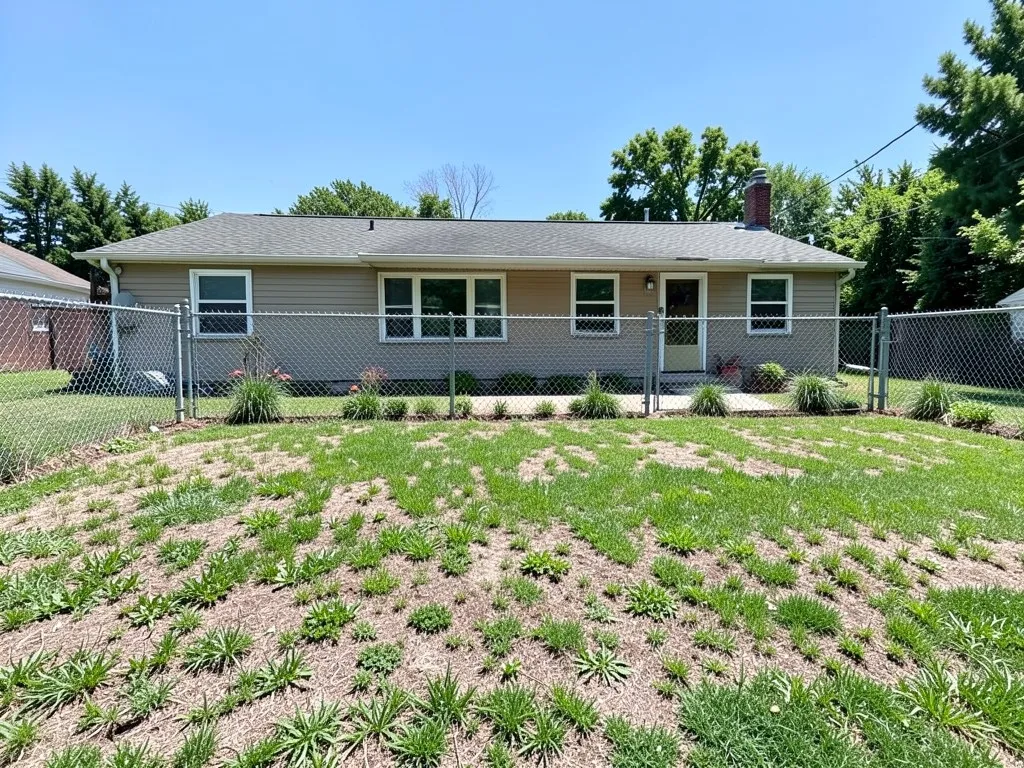
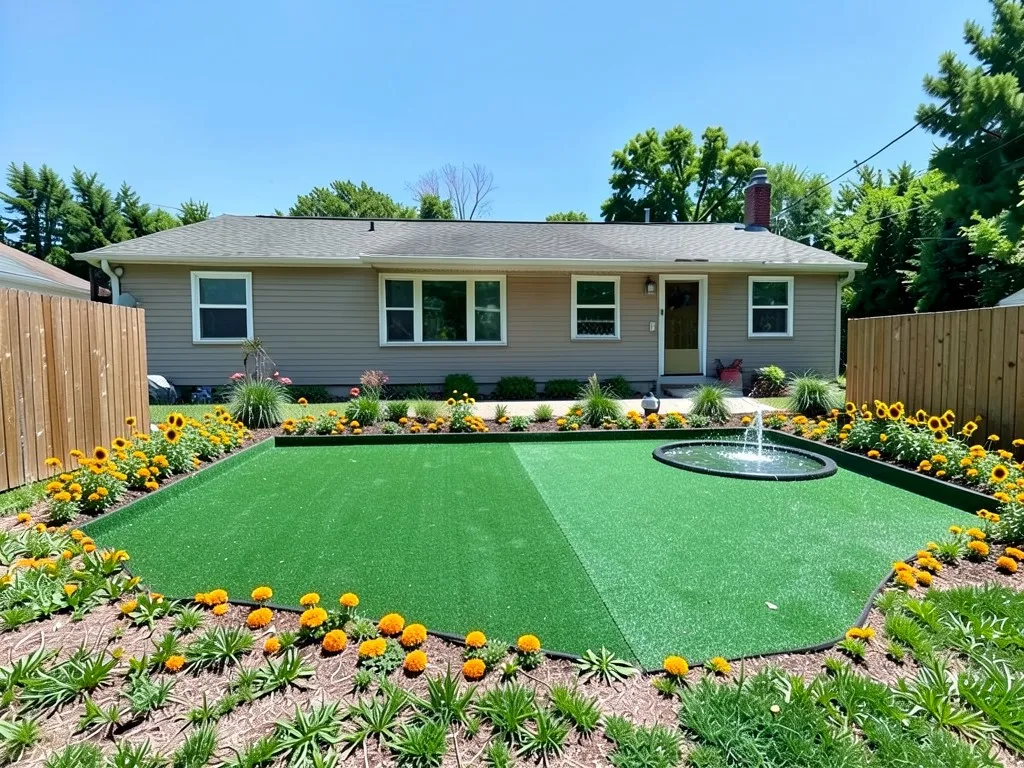
The AI shows the layout: where a path, dig pit, shade or turf could go. It does not know which plants are safe for your dog, whether a fence is escape-proof, or how the yard drains. In the examples above it left the mud, turned a splash pad into a fountain and only partly replaced a fence, so check each result before you build.
Dog-friendly backyard instructions to paste into Custom mode
These are the exact instructions we used for the two examples above, in the same order. In the tool above, Custom mode is selected: paste one into the Custom Design Requirements box, then upload your photo.
- Cover the muddy lawn with fresh green grass, and along the whole fence make a three foot wide path of loose reddish-brown cedar wood chips. Add a rectangular sand dig pit framed with wooden boards in the middle of the yard, and a tan shade sail over the concrete patio with a water bowl on it. Keep the fence, the house, the concrete patio, the sky and the camera angle exactly the same
- Replace only the patchy grass with a play area of artificial turf, add a small low splash pad, borders of marigolds and sunflowers set back from the fence, and replace the chain link fence with a tall wooden fence. Keep the house, the trees, the sky and the camera angle exactly the same
Four more dog-friendly examples: safe plants, a dig-proof fence, a paw-friendly path and raised beds
Four more pairs try the ideas above: a border of plants from the ASPCA's non-toxic list, a solid fence with stones along the bottom, a worn dog track turned into a flagstone path, and raised beds in place of a trampled bed. The exact instruction is printed under each pair; paste it into the Custom box in the tool above and change it for your yard. The pictures show a layout; they cannot tell you whether a plant is safe or a fence is escape-proof.
A border of dog-safe plants by the fence
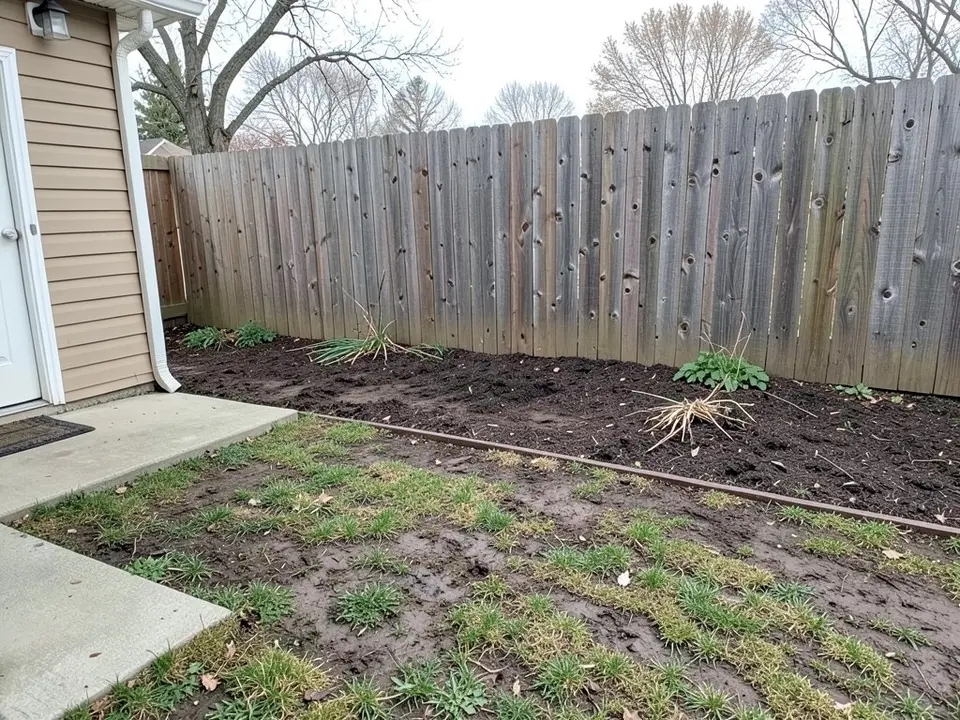
Before
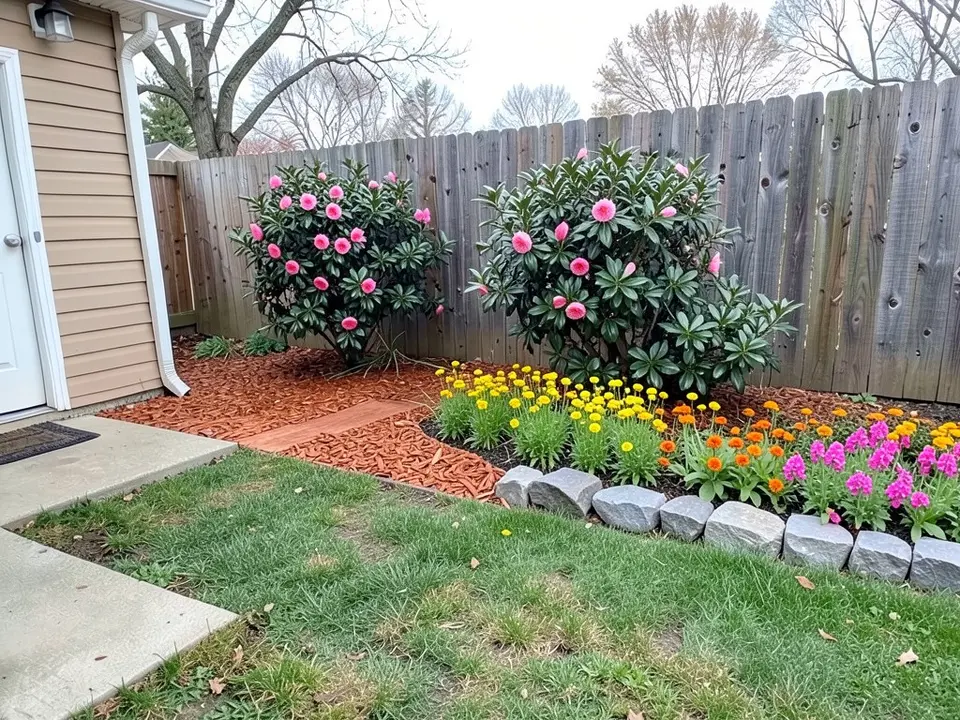
After
Instruction we used: Along the fence, keep a three foot wide path of reddish-brown cedar wood chips right against the fence, and in front of the path plant a densely planted border: two glossy dark green camellia shrubs with pink flowers at the back, a row of yellow coreopsis and orange calendula marigolds and pink snapdragons at the front, edged with a low row of grey stones. Cover the worn lawn with fresh green grass. Keep the fence, the house, the patio, the sky and the camera angle exactly the same.
A solid fence with stones against digging
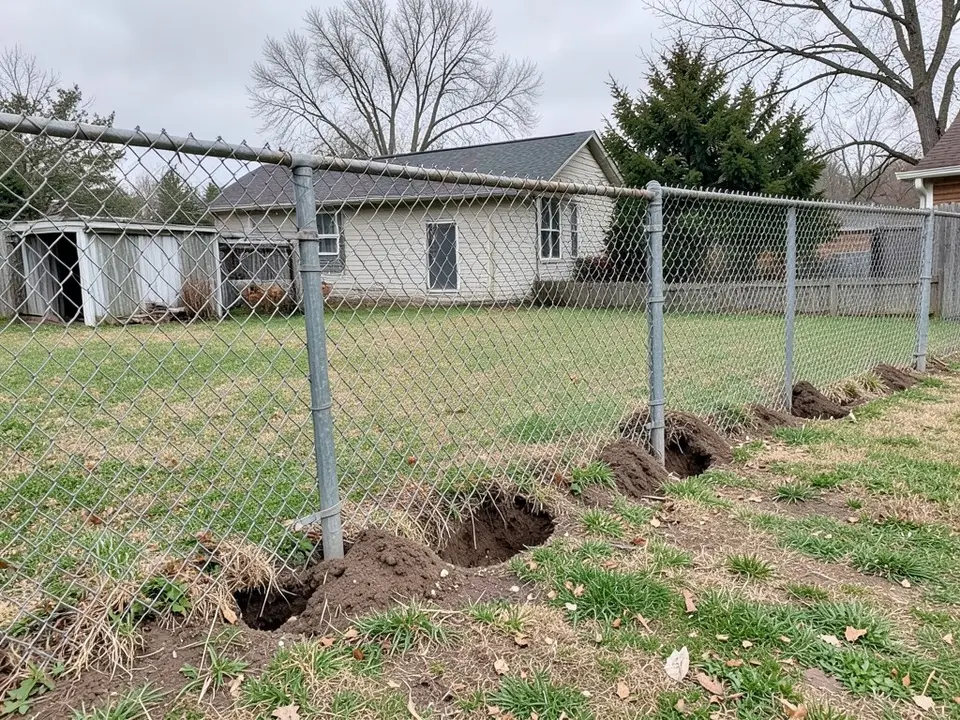
Before
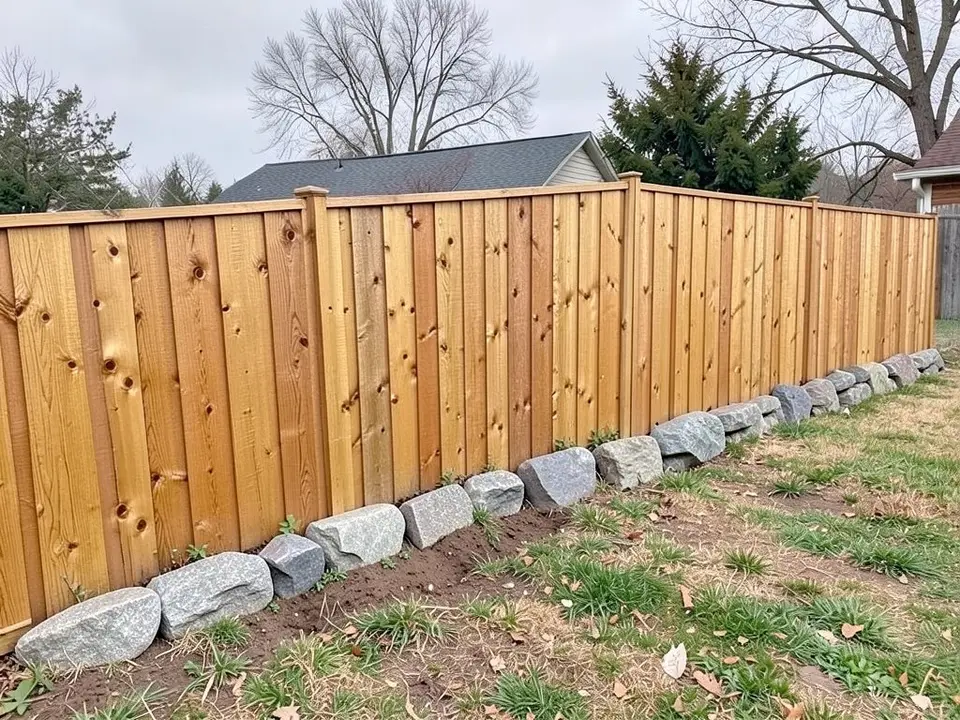
After
Instruction we used: Replace only the chain link fence with a tall solid cedar wood privacy fence about six feet tall, with a row of large flat grey stones laid along the bottom of the fence to stop digging, and fill in the dug holes with level soil and grass. Keep the lawn, the trees beyond, the sky and the camera angle exactly the same.
A worn dog track turned into a path
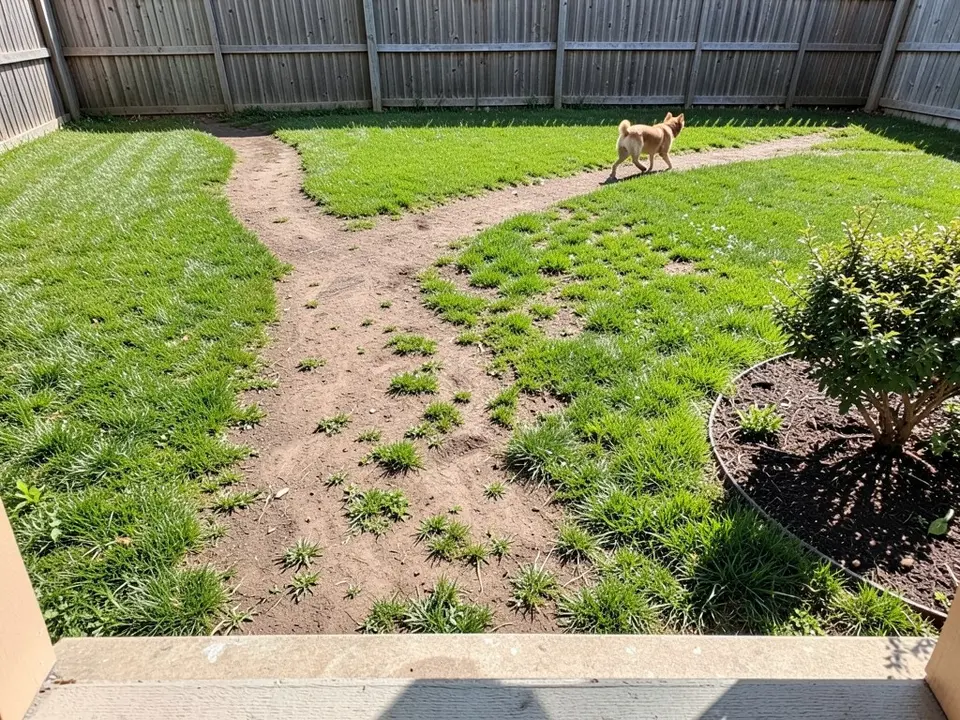
Before
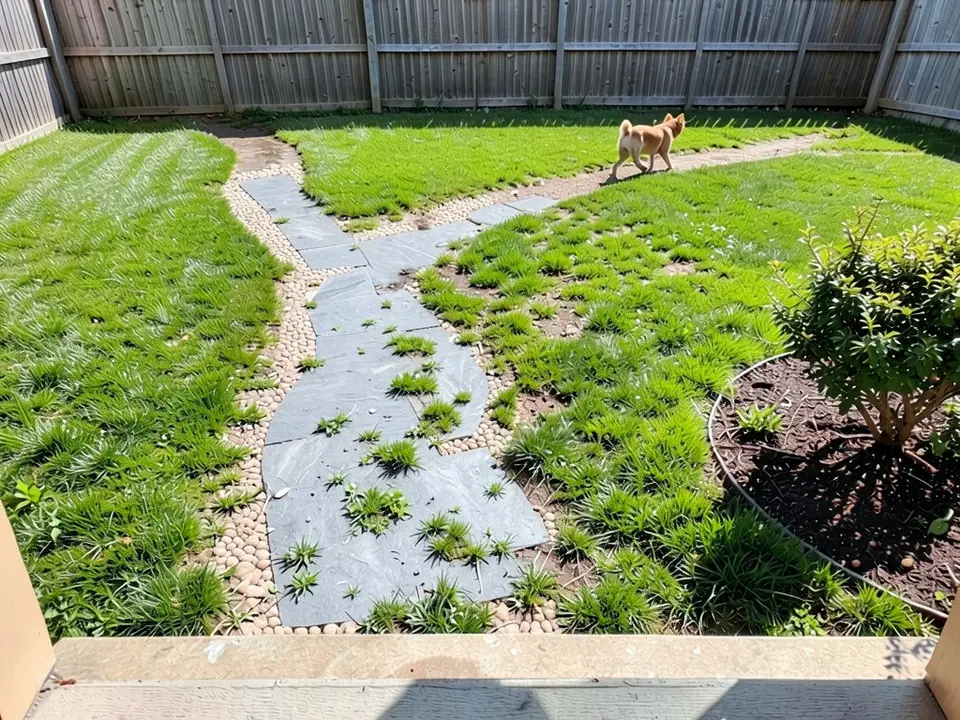
After
Instruction we used: Turn only the worn dirt track into a curving path of large light grey flagstones set in smooth pale pebbles, with low creeping thyme growing between the stones, following exactly the same curve. Keep the lawn, the fence, the shrub bed, the steps, the sky and the camera angle exactly the same.
Raised beds in place of a trampled bed
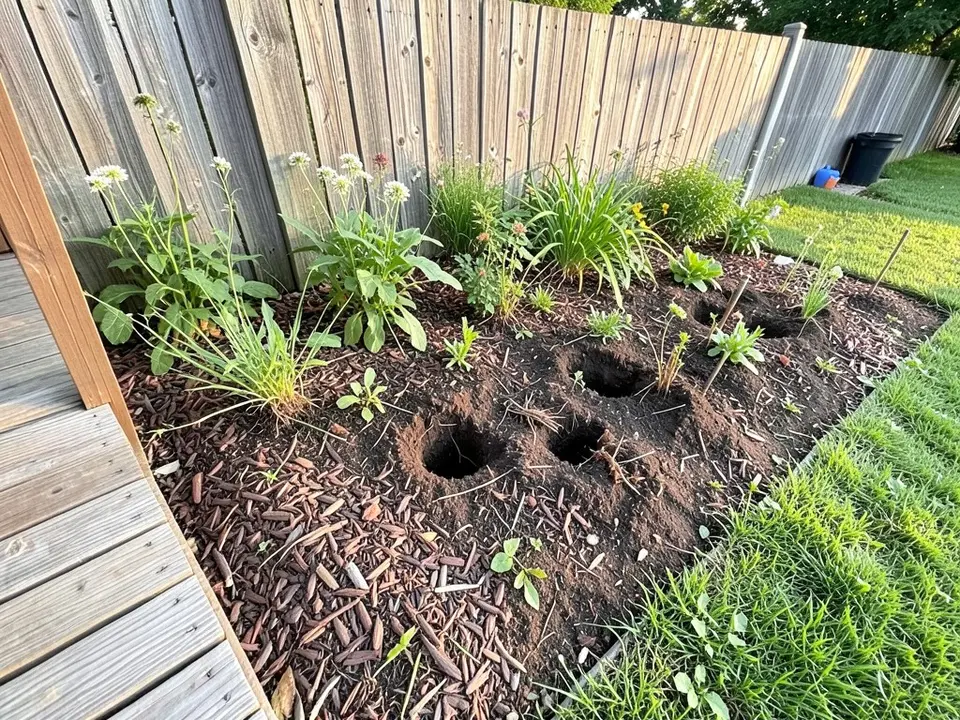
Before
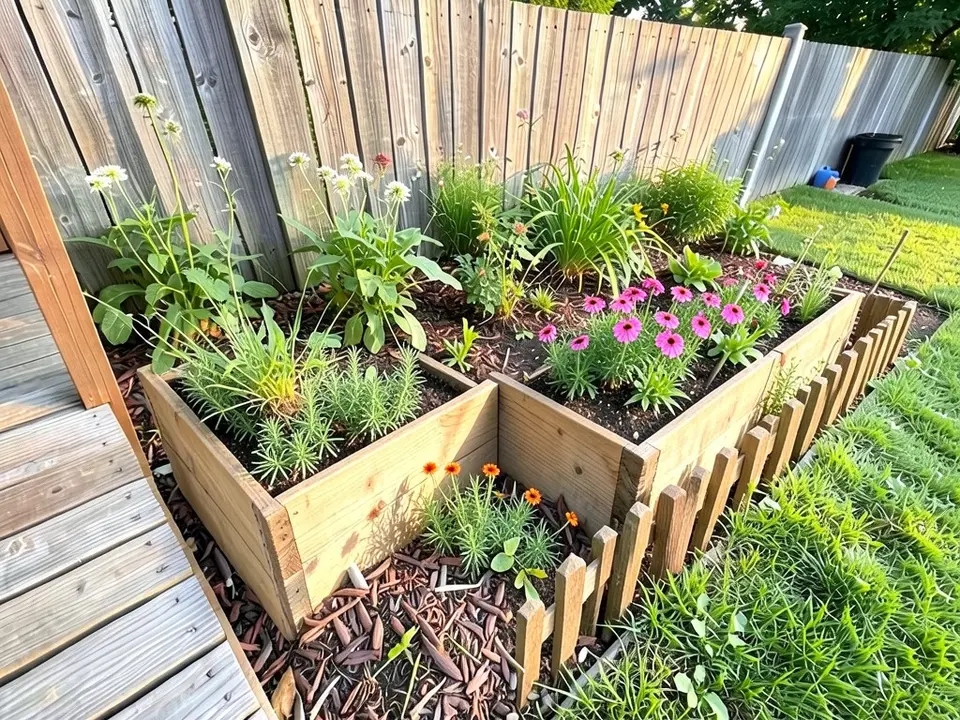
After
Instruction we used: Replace only the trampled flower bed with two raised garden beds of natural wood boards about eighteen inches tall, planted with rosemary, thyme, zinnias and pink snapdragons, and a short low wooden picket border around the lawn side. Keep the deck, the fence, the lawn, the sky and the camera angle exactly the same.
Frequently asked questions
What plants should I avoid in a backyard with dogs?
The ASPCA lists sago palm, oleander, azalea, yew, foxglove and lily of the valley as toxic to dogs. Also avoid cocoa bean mulch. Check every plant on the ASPCA list before you plant it.
How do I stop my dog wearing a path along the fence?
Work with it: give the fence line a path about 2 to 3 ft wide of wood chips or gravel, and keep beds and lawn off that strip.
Is lavender safe for dogs?
The ASPCA lists English lavender (Lavendula angustifolia) as toxic to dogs. Rosemary and common thyme are on its non-toxic list, so a herb bed of those suits a dog yard better.
What is the best ground cover for a yard with dogs?
Lawn Love suggests white clover, which is soft, drought-tolerant and less likely than turfgrass to show urine spots, and creeping thyme between stepping stones. On the busiest dog routes, the pages we read suggest a path of cedar chips, flagstone or smooth gravel instead of any plant.
What mulch is safe for dogs?
Penn State Extension suggests natural wood chips such as cedar or pine, and Lawn Love suggests undyed arborist chips, cedar or cypress. Avoid cocoa mulch (it contains theobromine), pine needle mulch (WSU Extension says it can damage a dog's stomach lining) and rubber mulch.
How do I stop my dog digging under the fence?
Sunset suggests an underground barrier of rebar, chicken wire or poured concrete along the fence line, or boards along the bottom of the fence. A sand dig pit somewhere else in the yard gives the dog an allowed place to dig.
Is the AI landscape tool free?
Yes, to start: 1 free render with a free account, and free renders carry a watermark. Upgrading to a paid plan gives you more renders and no watermark.
More sources
The plants to avoid above come from the ASPCA. We added these six pages in November 2026 for the dog-safe plant table, the fence and border ideas and the path surfaces; each fact above names the page it comes from.
- ASPCA Animal Poison Control: Toxic and Non-Toxic Plant List, Dogs
- Penn State Extension: Petscaping, Creating a Pet-Friendly Garden
- Sunset: This Is the Trick to Creating a Garden Your Dog Won't Mess Up
- WSU Extension, Skagit County: Pet Friendly Gardening (Deborah Leitner, Master Gardener)
- Lawn Love: Barkitecture, 12 Dog-Friendly Landscaping Ideas for Your Backyard (Maria Isabela Reis, updated 7 August 2026)
- Milorganite: Dog-Friendly Landscaping Ideas
More yard ideas
- Artificial grass for dogs
- Backyard fence ideas
- No grass backyard ideas
- Shade sail ideas
- Backyard playground ideas
- Small backyard landscaping ideas
Want to see any of these on your own yard? Open our AI yard design tool, upload a photo and describe the change, or browse all AI design tools.